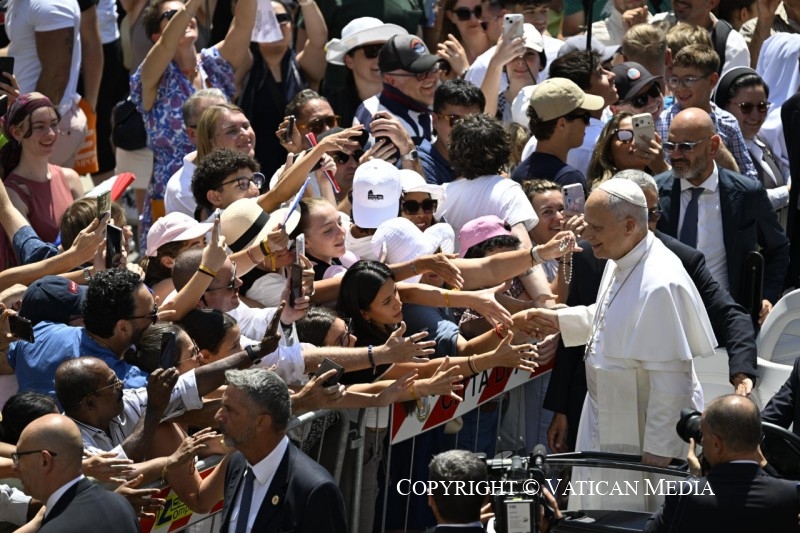




Dear brothers and sisters, happy Sunday!
In today’s liturgy, the Evangelist Matthew presents us with the Parable of the Sower (cf. Mt 13:1–23), which describes the generosity and trust with which God sows his Word in our hearts and his power in us.
Jesus himself, the Word made flesh, who gave his life for our salvation, is the seed that the Father continues to sow throughout the world so that, by dying, he may bear much fruit (cf. Jn 12:24). It is true that sometimes he finds in us hard and unresponsive soil, at other times distracted soil, like the beaten path, the rocky ground, or the thorny bushes. Yet there are also moments when he finds receptive and fertile ground, and then miracles of love are set in motion that have the power to transform everything — as we ourselves have no doubt experienced in our own lives. For this reason, the Father never ceases to sow, because he knows that the power of his love is stronger than our weakness (cf. 2Cor 12:9–10).

Referring to the “seed” of the Word of God, Saint John Chrysostom asks, “How could it be reasonable to sow among thorns, on rocky ground, or on the path? In the case of seeds and soil, it would not be reasonable; but in the case of souls and doctrine, it is altogether praiseworthy” (Homilies on the Gospel of Matthew, 44, 5), because in God’s hands it is possible that “rocky ground may be transformed into fertile soil; that the path may no longer be trampled underfoot or exposed to every passer-by, but become rich earth; and that the thorns may be cleared away and the seed may enjoy complete security” (ibid.).
God’s generosity towards us is not naïve but wise. He sees within us the potential of a good that, at times, we ourselves might fail to recognize. For this reason, the Lord, who knows the soil of our hearts better than we, never ceases to believe in us — in who we are and in who we can become, day by day, if we entrust ourselves to him in faith.
Thus, from the generosity and trust with which the seed is sown, and from the humility and openness with which it is received, the fruits of the Holy Spirit grow within us and spread. Saint Paul teaches that they are “love, joy, peace, patience, kindness, goodness, faithfulness, gentleness, and self-control” (Gal 5:22). How greatly our world stands in need of these fruits: to be filled with them and transformed by them!

Let us therefore resolve, especially during these summer days of vacation, to make room for listening to, reading, and meditating on the Word of God, thereby fostering—together with rest and wholesome recreation — meaningful moments of silence and prayer. In this way, we shall return to our usual activities renewed in body and spirit, ready to proclaim the Good News of the Gospel and ever more capable of contributing to the growth of the Kingdom of God.
May Mary, Queen of the Apostles and Star of the Evangelization, help us.
Source: vatican.va