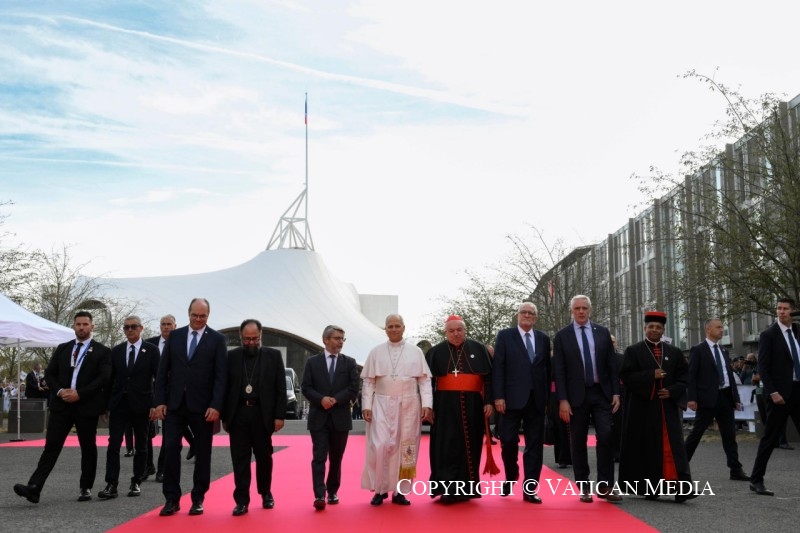




Address by Pope Leo XIV
Dear brothers and sisters,
Dear friends and representatives of various religious traditions,
It is with joy, but also with a keen sense of spiritual responsibility, that I stand among you today in Metz, a city of borders and crossroads, at the Robert Schuman Center, named after one of the founding fathers of the European Union. This man of faith and conviction knew how to transform old dividing lines into bridges of hope for all of Europe, becoming a true ambassador of unity in diversity. Following his example, our shared responsibility as men and women of faith is to bear witness that, beyond all borders, it is always possible to meet one another, forge friendships, and seek peace.
Dialogue does not diminish our identity, but expresses it with simplicity and truth by opening it to the diversity of the other. As my predecessor Pope Francis wrote, “Dialogue between the followers of different religions does not take place simply for the sake of diplomacy, consideration or tolerance… ‘the goal of dialogue is to establish friendship, peace and harmony’” (Encyclical Letter Fratelli Tutti, 271). Beforehand, Saint John Paul II regarded dialogue as an intrinsic requirement of human nature itself (cf. Message for the World Day of Peace, 1 January 2001, 10). According to Paul Ricœur, this is the path through which we recognize otherness as a promise rather than a threat. It is an art of encounter that our world sorely needs, and it is the very opposite of aggression and violence.

Indeed, to invoke God’s name in order to justify violence or oppression is to profane that name. Nothing that disfigures human dignity can claim to be inspired by God. Religious discourse must constantly call for the disarmament of hearts and words. This places a direct responsibility on each of us as guardians of our respective traditions.
Moreover, if the fruitfulness of religious traditions is seen above all in their service of peace and fraternity, it is also expressed in their ability to protect, accompany and serve life. The greatness of a civilization is not measured by its material achievements, but by the way it cares for, protects and upholds the human person. Religions are guardians of life, for they affirm its sacred value. Their fruitfulness is shown in their loving presence alongside those who are most vulnerable and fragile. To serve life means to surround it with care, presence and tenderness, especially in times of trial, right to the very end. For those of us who are open to transcendence, our mission is to offer sound points of reference, especially to young people, to help build a communion that respects and upholds the dignity of every human person.

Dear friends, “the Church regards all who sincerely seek ‘truth, goodness and beauty’ as companions on the journey” (Encyclical Letter Magnifica Humanitas, 23). Once again, I thank you for your closeness and your presence. May the infinite goodness and wisdom of God accompany us and teach us to live ever more fully as his children and as brothers and sisters to one another. Thus, wherever we live, may we be artisans of peace and witnesses to a hope that never ceases to grow in our world.
May God bless you.
Source: vatican.va