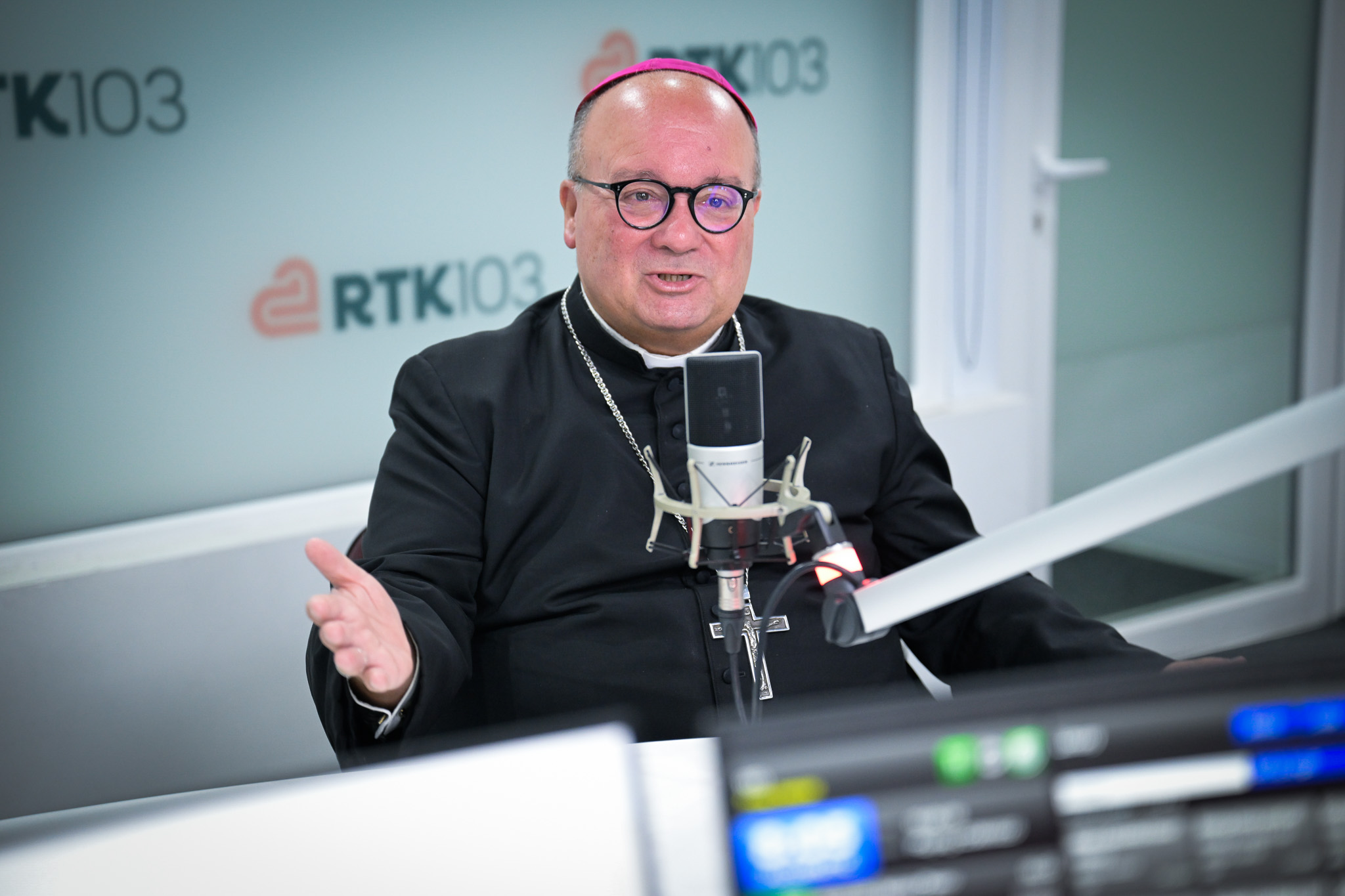




Archbishop Charles Scicluna used a wide-ranging interview on RTK103 to defend his right to speak out on Malta’s most contentious issues, stressing that a bishop’s counsel remains that of a friend even when it is unwelcome.
Speaking to Christine Delicata on RTK103’s Għal Kulħadd programme he insisted instead that honesty demands self-criticism, noting the Church, like any institution, is imperfect and makes mistakes.
The remarks came four months after Scicluna underwent a successful surgical procedure in May, followed by knee ligament surgery in July after a fall, recoveries he referenced by saying his own experience of reduced mobility had left him newly grateful for movement itself, and for the doctors, researchers and scientists who make such treatment possible.
Much of the interview revisited themes from his State of the Nation address on 4 September, in which he warned that Malta risked “state capture” if informal networks of money and influence continued to outweigh formal institutions.
He returned to that warning on RTK103, saying it is a defeat when money decides what happens beyond our shores, and adding that people must trust the law applies equally to everyone. Pressed on whether Malta’s rule of law was fundamentally absent, he was careful to distinguish between an imperfect system and a broken one, arguing the strength of institutions and the country’s reputation are what is really being tested.
Archbishop Scicluna said Malta, like the rest of the world, is susceptible to the power of big corporations and multinationals with turnovers larger than many countries’ GDP. “Whoever has financial power and lurks in the shadows must not replace democracy,” he warned. He stressed that wealth and justice must be equal for everybody, adding that if financial power can bribe authorities, this also betrays the weaknesses of institutions.
He also addressed the rule of law, saying it is not that it is completely missing in Malta, but that it depends on how strong institutions are and on the country’s reputation. “People must be confident that the law is equal for everybody,” he said. “Whoever wants to understand me, can understand me.”
Asked to look fifty years ahead – a central theme of his State of the Nation speech – Scicluna said the priority was not fear but responsibility, insisting Malta must “roll up its sleeves” because everyone, from political and religious leaders to ordinary citizens, shares the duty of leaving a better country behind.
He spoke of children’s yearning to live in harmony with nature, recalling how ancient trees in the Maltese countryside remind him that someone planted them long ago to be enjoyed centuries later. “When I see a tree such as a carob tree that is hundreds of years old, I am reminded that somebody planted it long years ago to be enjoyed by us hundreds of years later,” he said. “And in the same manner, we must do the same and plant seeds for a better future for future generations.” He underlined the importance of long-term planning, resource management, and investment in infrastructure that supports the economic model.
That long view extended into his most pointed policy contribution: Malta’s fertility rate, the lowest in the EU. Echoing language from his Independence Day homily on 21 September, in which he asked whether Malta had gone “from being the colonised to the colonisers” in its treatment of migrant workers, he argued the birth-rate crisis cannot be solved by tax breaks and allowances alone. Parents who stay home with their children, he said, are doing important work, declaring plainly that “whoever has children holds the future.”
The interview also touched on his recent private meeting with Michael Vella, father of murdered journalist Daphne Caruana Galizia, held the day after his Independence Day Mass, the same day an appeal was filed against Yorgen Fenech’s controversial acquittal. Scicluna described Vella as a man of striking dignity despite his grief, saying the thought of how Daphne was killed still shakes him to the core. He noted Daphne should not be canonised, but insisted it is time for the Vella family to see justice done, calling the situation not the Malta anyone wants.
“This is not a nice moment for Malta, and this is not the Malta we want,” the Archbishop said.
On immigration, Scicluna reiterated concerns first raised in his homily about migrants living in inhuman conditions, warning that forced immigration cannot be managed without adequate infrastructure, even as he acknowledged Malta’s genuine need for foreign labour. He also urged restraint in construction, arguing Malta and Gozo are not infinitely elastic, and that quality of life requires curbing the impulse to build on every remaining plot.
Source: Newsbook.com.mt
Article written by Jurgen Balzan