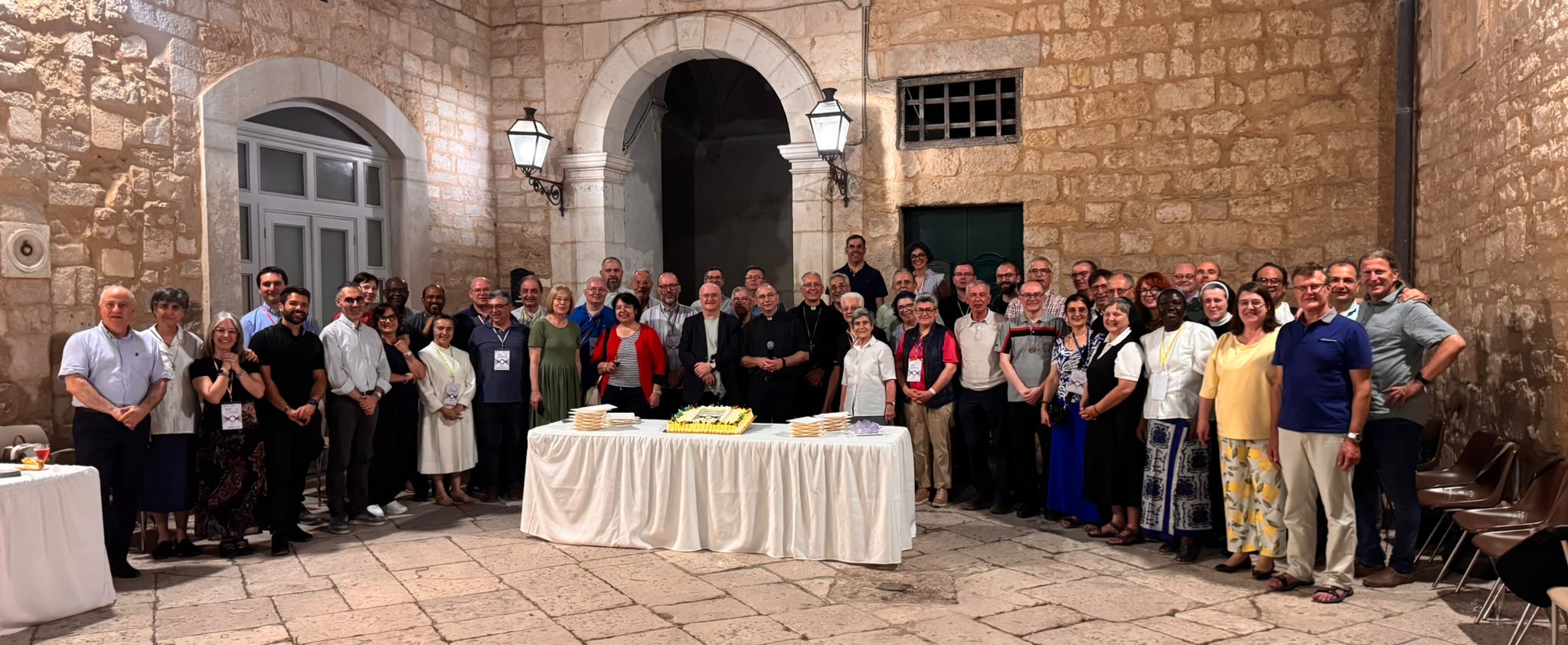





Rev. Prof. Carl-Mario Sultana convened and addressed the biennial Congress of the Équipe Européenne de Catéchèse of which he is the President. The meeting was held in Corato, near Bari in Italy and between 3 and 8 June 2026. It brought together more than 60 participants from more than 17 European countries. The participants were either national directors of Catechesis and/or Religious Education in their countries or academics in higher educational institutions in Catechetics and/or Religious Education. The theme of the meeting was Catechesis for Encounter and for Peace. “Bringing together the Differences”.
In his introduction to the theme, Fr Sultana emphasized the fact that catechesis has a decisive role to play in promoting peace in a European context marked by conflicts, identity tensions and social fragmentation. The Maltese priest argued that catechesis must go beyond simple doctrinal transmission to become “a laboratory of peace,” capable of helping people “build authentic relationships with Christ and with one another.”
Before approximately 60 participants from 17 European countries the president of the European Catechesis Team warned of the growth of an “identity-based hermeneutics” that leads to seeing one’s neighbor not as a gift, but as a threat. According to Fr Carl-Mario Sultana, the problem of encounter and peace arises from the tension between “globalized indifference” and “fragmented particularism,” phenomena that profoundly mark contemporary European culture. In this context, he considered that catechesis should “favor the creation of spaces for encounter and dialogue, where differences are welcomed and not transformed into a reason for division.”
Inspired by the prophetic vision of Don Tonino Bello, former bishop of Molfetta-Ruvo-Giovinazzo-Terlizzi, Fr Sultana evoked the expression “conviviality of differences,” explaining that peace does not consist in the elimination of differences nor in the standardization of identities, but in the ability to live communion while preserving the uniqueness of each person and of the community. Throughout his speech, the president of the European Team for Catechesis identified four main challenges for contemporary catechesis: the epistemological challenge of proclaiming Christian truth while respecting plurality; the ecclesiological challenge of living reconciliation in diversity within the Church itself; the anthropological challenge of learning from encounters with others; and the pedagogical challenge of educating for peace as a way of life and not merely as the absence of conflict.

Fr Carl-Mario also highlighted the importance of synodality, attentive listening, and accompaniment as fundamental elements of catechetical action, emphasizing that the truth is not something the catechist possesses, but a Person, Jesus Christ, who comes to meet us where we stand.
His intervention also marked the 75th anniversary of the founding of the European Catechesis Team, created in 1950 during the First International Catechetical Congress held in Rome. Fr. Carl-Mario Sultana recalled that the organization’s mission continues to be to promote encounters between those responsible for catechesis and experts in the same field to foster reflection on the cultural challenges faced by the Christian faith and evangelization.
“After 75 years, the differences in Europe are no longer just national, but also cultural, secular, and digital,” he said. “Our history demonstrates that the Team is not afraid of these differences. On the contrary, it offers a space where we learn that peace is not the absence of debate, but the presence of the Spirit in our diversity.”
Over six days, the congress will explored how catechesis can contribute to forming communities capable of promoting encounter, communion, and peace, and in this way living the differences.