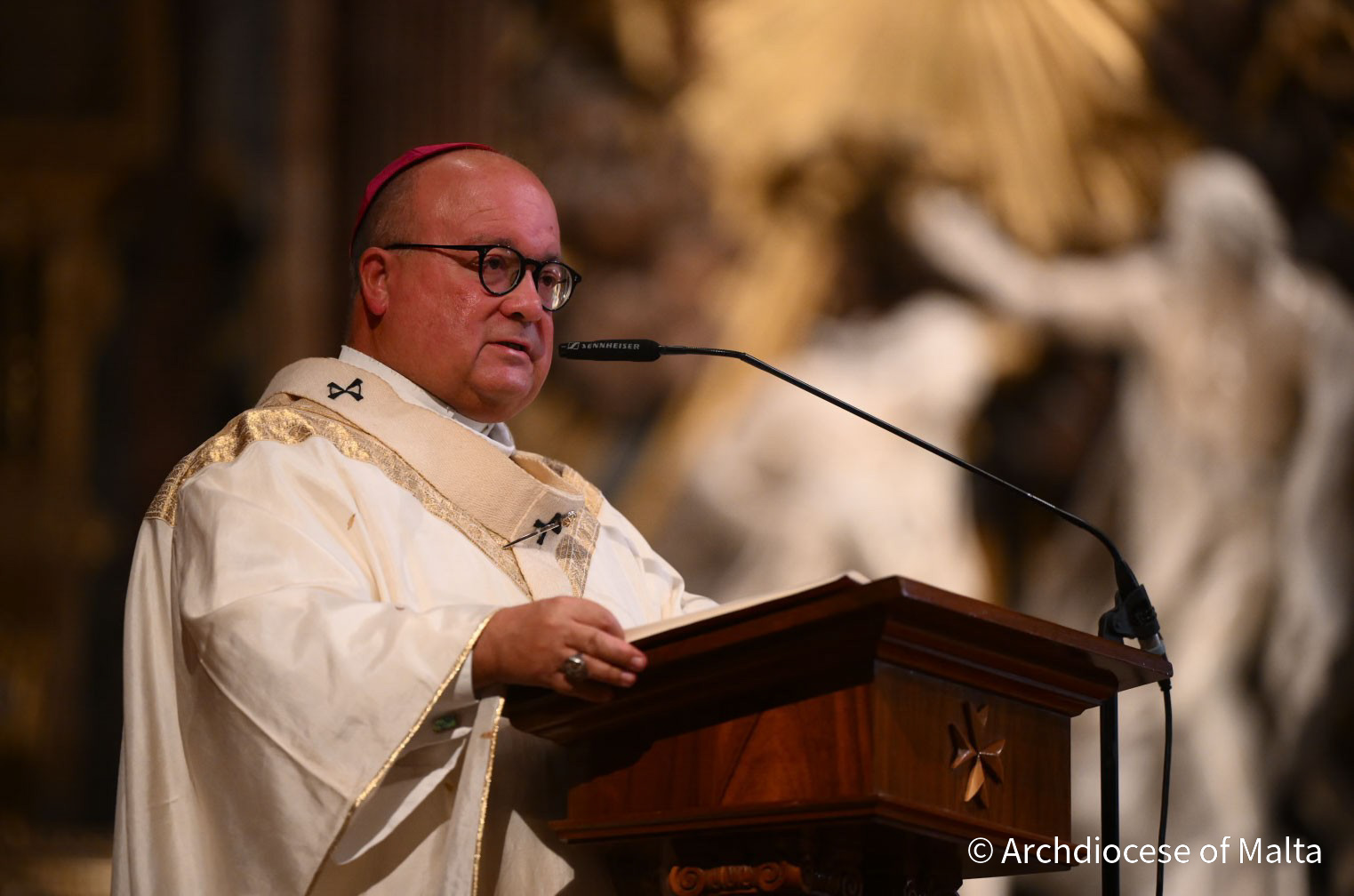




Homily by Archbishop Charles Jude Scicluna
Dear brothers and sisters,
Today we give thanks to God for our beloved Malta, for the freedom we inherited and for those who sacrificed so much so that our country could determine its own future.
But independence is more than an achievement of the past. It is a responsibility entrusted to every generation. Freedom gives us the possibility to shape our future, wisdom determines whether we shape it well.
In today’s Gospel, Jesus gives us a strikingly practical image:
“Which of you wishing to construct a tower does not first sit down and calculate the cost to see if there is enough for its completion?” (Lk 14:28)
Jesus is speaking about discipleship. But his words also remind us of the virtue of prudence: the capacity to recognise what is truly good, to look ahead and to choose wisely.
This is an important virtue not only for individuals, but also for those entrusted with governing a nation.
Malta has changed enormously in recent years. Our economy has expanded, employment has grown, and people from many countries have contributed their skills and labour to our prosperity and essential services.
For this we should be grateful… But rapid development and population growth also bring consequences. Our roads, housing, electricity supply, drainage and sewage systems, waste management, healthcare and environment all experience the pressures created by a growing economy and population.
Jesus tells the builder: before you build, sit down and calculate.
This is foresight, and Malta needs it.
Before encouraging further population growth and development, have we calculated what our infrastructure and environment can sustain and considered the quality of life of the people who live here?
The difficulties we have experienced with electricity, sewage, congestion, waste and relentless construction remind us that infrastructure cannot always be expected to catch up afterwards.
But prudence and foresight are also about the institutions upon which a free and democratic society depends.
In my recent address at the ‘State of the Nation’ conference, I spoke about the damage to our nation and its reputation from allegations of corruption and networks of money, influence, favours and protection.
I warned that when informal networks become more powerful than our institutions, the danger goes beyond individual acts of corruption. It becomes a threat to the integrity — and ultimately the independence — of the nation itself; a nation that belongs to us all irrespective of political colour or creed.
In the wake of this extremely painful episode for our country, some people chose to focus on their own bias, narrative or minor discomfort. I prefer to think of those carrying deep wounds that cannot simply be washed away by a few insults or carefully prepared words: like the family of Daphne Caruana Galizia, still seeking full justice for her heinous murder after nine painful years; and the many good people in our country who have lost faith in institutions they fear are serving networks of money and influence rather than the people they were created to serve.
My appeal is to those entrusted with public responsibility, and to all of us who have a duty to ensure that our institutions remain stronger than the interests that may seek to influence them. Ultimately, this is not about politics. It is much bigger than that. It is about what kind of country we want Malta to be, and whether people can trust its institutions to serve them with independence, courage and integrity.
And what we ask of the State, we in the Church must also be equally prepared to ask of ourselves.
As I have often said when discussing child protection, prudence and foresight are incompatible with omertà, or with arrangements that impose silence upon victims or their families.
Transparency, foresight and accountability must be values in the governance of both State and Church. When we, as leaders within the Church, fail in this responsibility, our witness sounds hollow and our ministry is compromised.
That same spirit of responsibility and foresight must guide the choices we make about our country’s future, including difficult questions about how Malta develops, how quickly it grows and how that growth is managed.
Rapid population growth places pressure on housing, healthcare and resources. Yet the human person must never be treated as the problem. Neither children, families nor migrants are economic units or demographic statistics.
Malta has benefited enormously from foreign workers, many of whom care for our elderly and sick and provide services on which we depend. They deserve our gratitude, but also justice. A migrant is not simply a pair of hands. No economic model should depend upon people accepting conditions we would consider unacceptable for ourselves or our children.
At the same time, we must ask whether continuous substantial population growth is sustainable for islands of our size. We should invest in our own people while welcoming foreign workers where genuinely needed and treating them with dignity.
On Independence Day, we should also ask how we measure national success.
Economic growth, investment and employment matter. But GDP cannot tell us everything about the wellbeing of a nation.
Can young people afford a decent home? Can our elderly receive the care they deserve? Are workers treated with dignity? Can people trust the institutions established to serve them? Can we preserve more protected green spaces? And will the Malta we leave our children be not merely richer, but better than the Malta we inherited? These are the real measures of progress.
Good governance requires an honest assessment of what we can sustainably support, institutions strong enough to protect the common good, and people within them with the courage to place duty above money, influence, friendship or favour.
Towards the end of today’s Gospel, Jesus speaks of salt losing its taste. His words offer us a final image for our country. Malta must not lose its flavour.
In pursuing prosperity, we must not sacrifice what makes these islands worth living in: our environment, communities, heritage, hospitality, solidarity, integrity and respect for human dignity.
Independence gave Malta the freedom to shape its future. Our responsibility is to shape it wisely – and to safeguard the independence and integrity of the institutions through which that freedom is protected.
May God grant wisdom and prudence to those who govern us; integrity and courage to those entrusted with our institutions; justice to those who employ others; compassion towards those who come among us; and to all of us responsibility for the country entrusted to our care.
May He also grant those of us entrusted with leadership in His Church the humility to recognise our failures, the courage to correct them and the wisdom always to place truth, justice and the protection of the vulnerable at the heart of our ministry.
May we build a Malta that is prosperous but sustainable, welcoming but just, ambitious but prudent – a Malta worthy of those who came before us and of the generations still to come.
May God bless Malta and all those who call these islands home.
✠ Charles Jude Scicluna
Archbishop of Malta
Mass Readings
First Reading: Wisdom of Solomon 6:1–11
Responses: Psalm 112
Second Reading: Rom 13:1-7
Gospel: Lk 14:28-34