



L-omelija tal-Isqof Joseph Galea-Curmi
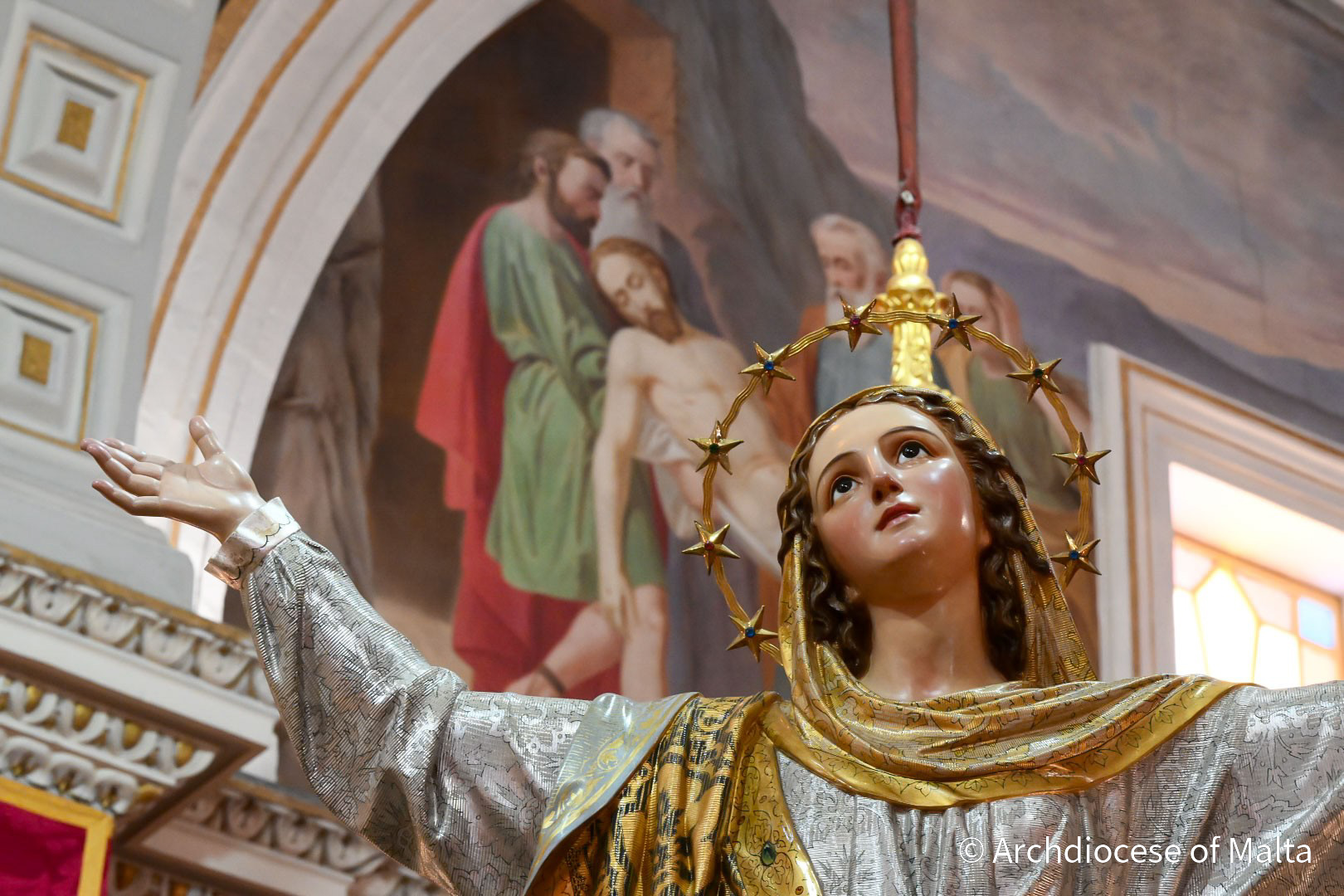
Ever since I was young, when I used to come to this parish church with my father, who lived here for many years, I have always been struck by the statue of Santa Marija, so deeply cherished by the people of this parish. I find it exceptionally beautiful. And I see in it a powerful expression of the mystery at the heart of this community’s identity: the Assumption of Mary into Heaven.
On this feast of the Assumption, she appears before us as a woman who has reached her fulfilment. Her life did not end in the grave. The human body God created, and Mary gave to the Son of God, the body through which she lived her faith, was received into glory.
On this feast day of the Assumption, let us reflect on this titular statue, appreciating its beauty and understanding the message it holds for our daily lives.
Mary’s eyes: a gaze towards Heaven
If we look at the statue, the first thing that strikes us is Mary’s gaze. Her eyes are raised towards Heaven. Mary immediately directs our gaze towards the Lord. She does not tell us: look at me and stop there; rather, she wants us to look towards the Lord.
Mary knows where she comes from, and she knows where she is going. In a world that often looks only towards the ground – to what is immediate, to what gives me pleasure, to what brings me comfort, to what has value according to money, success or usefulness – Mary teaches us to raise our eyes upwards. True goodness comes from God.
The value of the human person does not begin with what they can do.
It is when we look towards Heaven that we recognise who the human being truly is. If the human being is no longer seen as a creature made in the image of God, then his or her value begins to be measured according to how strong and powerful they are, how much money they have, how productive they are, how independent they are, or how much they can contribute to society. But before God, it is not so. The value of the human person does not begin with what they can do. It begins with the fact that they are created by God and loved by him. And, therefore, human life possesses a dignity that we can never take away – not even when a person has not yet been born but already exists; not even when they are sick, or very old and frail, or when they are suffering; not even when they are unable to do anything.
From the moment life begins in the mother’s womb until its final breath, every human life remains precious, remains loved by God, and continues to possess a dignity that no one has the right to take away. Mary, with her eyes turned towards Heaven, gives us this powerful message: turn your gaze towards God, and he will help you to look at every human being as God looks at them.
Mary’s open hands: a life that welcomes
Then we see Mary’s open hands. Open hands are a sign of one who welcomes, one who trusts, one who gives.
To the Archangel Gabriel, when he came to give her the greatest News, Mary said: “Behold, I am the handmaid of the Lord; may it be done to me according to your word!” (Lk 1:38) She welcomed the Lord’s invitation with open hands, even though she did not understand everything clearly. As Elizabeth said: “Blessed are you who believed that what was spoken to you by the Lord would be fulfilled” (Lk 1:45). Open hands reveal an open heart. Here we have an important message: that, like Mary, our hands and our hearts should be open, ready to welcome what God asks of us, with the same trust as Mary.
The baby’s life and the mother’s dignity do not compete with one another.
Mary’s open hands also show us how she welcomed Jesus into her womb. Elizabeth says to her: “Blessed is the fruit of your womb” (Lk 1:42). The womb should be the first home of the human being, where he or she is welcomed. How beautiful is the new life that God entrusts to a mother and father! And how much should we, as a society, do our utmost to create conditions in which every mother, especially one who finds herself in a difficult situation, can look upon the baby she is carrying not as a burden, but as a life deserving of love, help and protection, a life that is welcomed wholeheartedly.
The baby’s life and the mother’s dignity do not compete with one another. We must be a community with open hands for both, a community that welcomes like Mary – welcoming the baby as a new human life, and welcoming the mother, telling the mother who finds herself in difficulty: you are not alone; we are with you. Our hands are open to welcome you.
Mary’s open hands remind us how important it is to be a welcoming Church. In the words of Pope Francis in his Apostolic Exhortation on the Joy of the Gospel: The Church should be a place “where everyone can feel welcomed, loved, forgiven and encouraged to live the good life of the Gospel” (Evangelii Gaudium, 114).
Mary’s open hands also remind us of her heart, open to everyone, especially the most vulnerable. They remind us of lives that need our protection: the trembling hands of an elderly man or woman, the hands of sick people who cannot care for themselves, the hands of those who are alone, those experiencing mental health difficulties, and those who are in the final stage of their lives.
The message of the Assumption, with Mary’s open hands, is clear: every life is precious. No life is disposable. No human being is superfluous. No person loses their dignity because they are weak. Someone who has lost hope in life must find in us the hands that lift them up, not hands that persuade them that it would be better for them to leave this life. This is the message Mary gives us: that the strength of a society is measured by the progress of those who are weakest.
Mary’s feet: walking on a journey
Then we look at Mary’s feet. They are in motion, with one foot further forward, as if to show us that faith is not only a gaze towards Heaven. Faith walks along the roads of the world until we reach our destination – Heaven.
Therefore, we have a duty to walk in the Lord’s way…not to regard someone as a burden or as someone who is no longer of value…
In her life, we often find Mary on a journey. She did not remain standing still before her mystery. She went to Elizabeth. She walked along the roads of life. She experienced joy and suffering. She passed through Bethlehem and Nazareth, also to exile in Egypt, through calm and anxiety, even as far as the hill of Calvary, and alongside the Christian community in its beginnings. And today, that journey of hers has ended in glory.
This reminds us that life is a sacred journey. From the moment a human being begins to exist, a journey begins which God wants to bring to its fulfilment. And, therefore, we have a duty to walk in the Lord’s way, to walk together with one another on this journey. Not to push aside those who are weak or get rid of them; not to regard someone as a burden or as someone who is no longer of value, but to recognise that we are all together on this journey towards our heavenly homeland. And Mary accompanies us.
Mary shows us the destiny of our bodies
Il-festa tal-Assunta għandha wkoll messaġġ profond dwar il-ġisem. Il-ġisem ta’ Marija, li llum naraw igglorifikat, ifakkarna li l-ġisem mhuwiex oġġett li nistgħu niddisprezzaw jew nużaw kif irridu.
The feast of the Assumption also has a profound message about the body. Mary’s body, which today we see glorified, reminds us that the body is not an object that we can despise or use however we please.
Our body has dignity because we are created in the image of God. And, therefore, this dignity is not derived from strength, beauty, intelligence or success. This dignity is not the result of popular approval. It is a gift from God that is never lost.
In the Magnificat, Mary says: “From now on all generations will call me blessed” (Lk 1:48). Why? Not because she had an easy life, or because everything went smoothly. Not because she did not suffer. Not because she never wept. But because God was with her and she was with him.
And the Assumption gives us true hope. It tells us that death is not the final word over our lives. The final word is life. Our destiny is not the grave. Suffering, illness and weakness are not the end. For those who believe in Christ, our destiny is glory.
A prayer
Therefore, as we celebrate the Assumption of Mary into Heaven, let us draw inspiration from this beautiful statue of your parish, and allow it to continue speaking to us. Her gaze towards Heaven tells us where our destiny lies. Her eyes tell us: raise your eyes towards the Lord and “Do whatever he tells you” (Jn 2:5). Her hands tell us: open your hearts to God and to every human life at every stage. Her feet tell us: walk the journey of life that leads to our heavenly homeland, and do not forget anyone along the way.
I would like to conclude with this prayer on the Feast of the Assumption:
O Mary assumed into Heaven, Mother
of Hope,
raise our eyes towards Heaven.
Open our hands to life, so that we may always protect it and cherish it
as a precious gift from God.
Guide our feet along the path of love that excludes no one, and
that accompanies the weak and the vulnerable.
Remain close to us and accompany us
until the moment when the Lord calls us to himself,
so that, like you, we too may reach the fullness of life,
and say forever: “My soul proclaims the greatness of the Lord” (Lk 1:46).
✠ Joseph Galea-Curmi
Auxiliary Bishop of Malta