



Homily of Holy Father Pope Leo XIV
“Senyor, sobirà nostre, que n’és, de gloriós, el vostre nom per tota la terra!” (Ps 8:1). With the praise of this psalm, so full of joy and wonder, I greet all of you, dear brothers and sisters. I express my gratitude to their Majesties. I thank Cardinal Juan José Omella, Archbishop of Barcelona, as well as my fellow bishops and all those who join us in prayer: priests, deacons and men and women religious. On this evening of celebration for the entire city of Barcelona, I extend grateful greetings to the public authorities, as well as to the members of other Christian communities and religions who are participating in our act of thanksgiving.
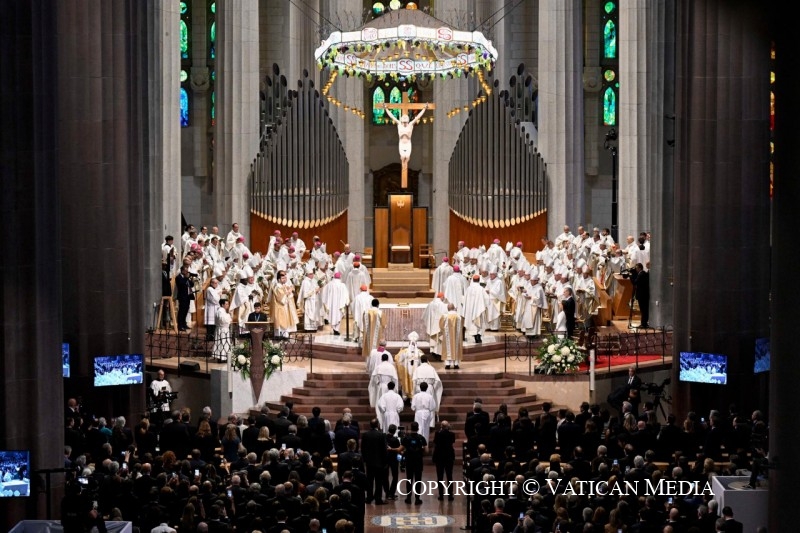
Today, the Basilica of the Sagrada Familia welcomes us to this beautiful city, opening its doors as though they were its arms, inviting each of us to this altar, to listen to the Word of God, which makes us a family loved by the Lord, nourished by his own life in the Eucharist. Thus, com la ciutat comtal and all Catalonia gather in this temple, as a sign of unity and harmony, and lift their gaze to encounter the face of God the Father, shining forth in his Son made man, Jesus Christ.
As we give thanks to the Lord for his love toward us, we praise him for his work in our lives. We thank him in particular for this extraordinary basilica, which Pope Benedict XVI consecrated in 2010, recalling that it is a visible sign of the invisible God, for whose glory its towers rise (cf. Homily for the Consecration, 7 November 2010). In continuity with the prayer of my Predecessor, in a few moments I will bless the highest tower, that of Jesus Christ.

This church is a single building made of many stones. A house that grows steadily over the years following a single plan. We are all the living stones of this edifice, which has Christ as its foundation and crowning glory, its beginning and end. Much more than a monument, the Basilica of the Sagrada Familia remains a work in progress today, reminding us that the Christian life is always a journey, because it is a project that God is carrying out.
We do not, therefore, dwell in an unfinished work, but in a temple still under construction. The fact that it is incomplete is not a flaw, for it bears witness to a desire; it does not signify a shortcoming, but rather expresses a promise that we wish to honor with consistency. Our gratitude thus becomes a commitment as we cooperate in God’s plan — that is, in the edification to which he himself calls us. Since we are the temple of the Holy Spirit (cf. 1 Cor 6:19), this work consists in our very lives, which God conceives as a masterpiece that we are to create together, and he calls us to collaborate with him (cf. 1 Cor 3:9).
In this regard, we hold dear in our hearts the words the Lord addressed to King David: “Are you the one to build me a house to live in?” (2 Sam 7:5). On the contrary, “the Lord declares to you that the Lord will make you a house” (v. 11). With this passage, Scripture teaches us that it is not we who make a dwelling for God, as if he were simply one thing among others or part of a whole greater than himself. Rather, it is God who makes a place for us, and the place he gives us is his own heart: the place of the Son, for us who were strangers; the place of the Beloved, for us who are sinners.
This desire of his is fulfilled through Jesus; we can then understand the meaning of what we heard in the Gospel, when the Lord says to the Pharisees: “you will die in your sins unless you believe that I am he” (Jn 8:24). These are strong words, which are by no means intended as threats or blackmail. They are an invitation to salvation — that is, a call to freedom extended by Christ, who desires for us the ultimate, eternal good. When faced with the threat of evil, the Lord is always with us, always on our side. “I am:” this is the Most Holy Name that God shared with Moses from the burning bush, revealing his unshakable faithfulness. As God made man, he becomes for us Emmanuel, the source of grace and forgiveness, of salvation and new life. That is why, if we do not believe in Jesus Christ, we remain in sin, and not only do we die, but we bring about the death of our neighbor. Dear brothers and sisters, we cannot believe in Jesus and promote war. We cannot believe in Jesus and kill the innocent even before birth. We cannot believe in Jesus and abandon those who suffer, those who weep, those who flee from misery.

Yes, the light of Christ shines in the darkness, even though the darkness has not received it (cf. Jn 1:5, 11). Yet this rejection does not mean that God’s love is lacking: “When you have lifted up the Son of Man,” says the Lord, “then you will realize that I am he, and that I do nothing on my own, but I speak these things as the Father instructed me” (Jn 8:28). It is necessary to pass through the passion of the crucified One to be enlightened by the glory of the risen One, for from the beginning, the Father teaches us to give our lives, and the Son, who receives life from him, gives it to all through the power of the Holy Spirit. This is precisely why the cross is the radiant sign of his love.
Tonight, then, let us remember that la Creu de Crist, which crowns this Basilica, és la Creu dels últims who become the first, of sinners who become saints, of the dead who will rise again. The three facades of the Sagrada Familia bear witness to this: the First becomes the last for us at the Nativity; through his sacrifice, he redeems us through his Passion; his death gives us eternal life, making us sharers in divine glory. As we admire the tower of Jesus Christ, we lift our gaze toward him, toward the One who alone reveals to us the truth about God and the truth about ourselves. By looking at Christ, we can see the world with renewed eyes: the tower of the cross then becomes a banner of charity, for God loves us in this way, transforming an instrument of death into a sign of hope. In Jesus’ cross, our faith reaches its summit, as professed by the inscription found at the base of the spire: “Tu solus Sanctus, Tu solus Dominus, tu solus Altissimus.” This cross shines by day, reflecting the sunlight, and shines by night, illuminating the city like a lighthouse overlooking the Mediterranean.
It is faith that shapes the stones and gives meaning to the edifice we inhabit together. In our prayer, therefore, we discover the original bond between all things and God, the Creator of heaven and earth. He is the Artist who has imprinted his splendor upon the cosmos. Created in his image, humanity responds to God’s work with its own ingenuity: this is how the artist transforms talent into praise and creativity into a testimony to the Creator himself. As an architect inspired by faith, the venerable Antoni Gaudí designed this place with the desire to narrate the mysteries of the Lord’s life. In this way, he has proposed to us a spiritual pilgrimage, leading to an encounter with Christ who for our sake was born, died and rose again. Together with Gaudí, as we commemorate the centenary of his death, we remember and give thanks this evening to all the supporters and benefactors, the artists and the workers who cooperated in the construction of an architectural masterpiece, which is also an eloquent catechesis made of stones, colors and light. In her wisdom, the Church thus renews the Biblia pauperum of the ancient cathedrals, which are in themselves rich messages of evangelization. In this age in which image is so prevalent, it becomes even more evident how art and beauty are privileged channels of evangelization.

Dear brothers and sisters, the beauty of this church inspires us to learn ever more from our Master and Lord the art of living according to his Gospel. As we lift our gaze toward him, the crucified and risen One, let us commit ourselves to lifting up those who lie in the dust (cf. 1 Sam 2:8). And let us show in this way that the Sagrada Familia is the tallest church in the world, not so as to stand out in worldly rankings, but rather to guide the steps of the People of God who make their pilgrimage in Spain, with the Cross illuminating their path, like a lamp burning brightly as we await the return of the Bridegroom.
Source: vatican.va