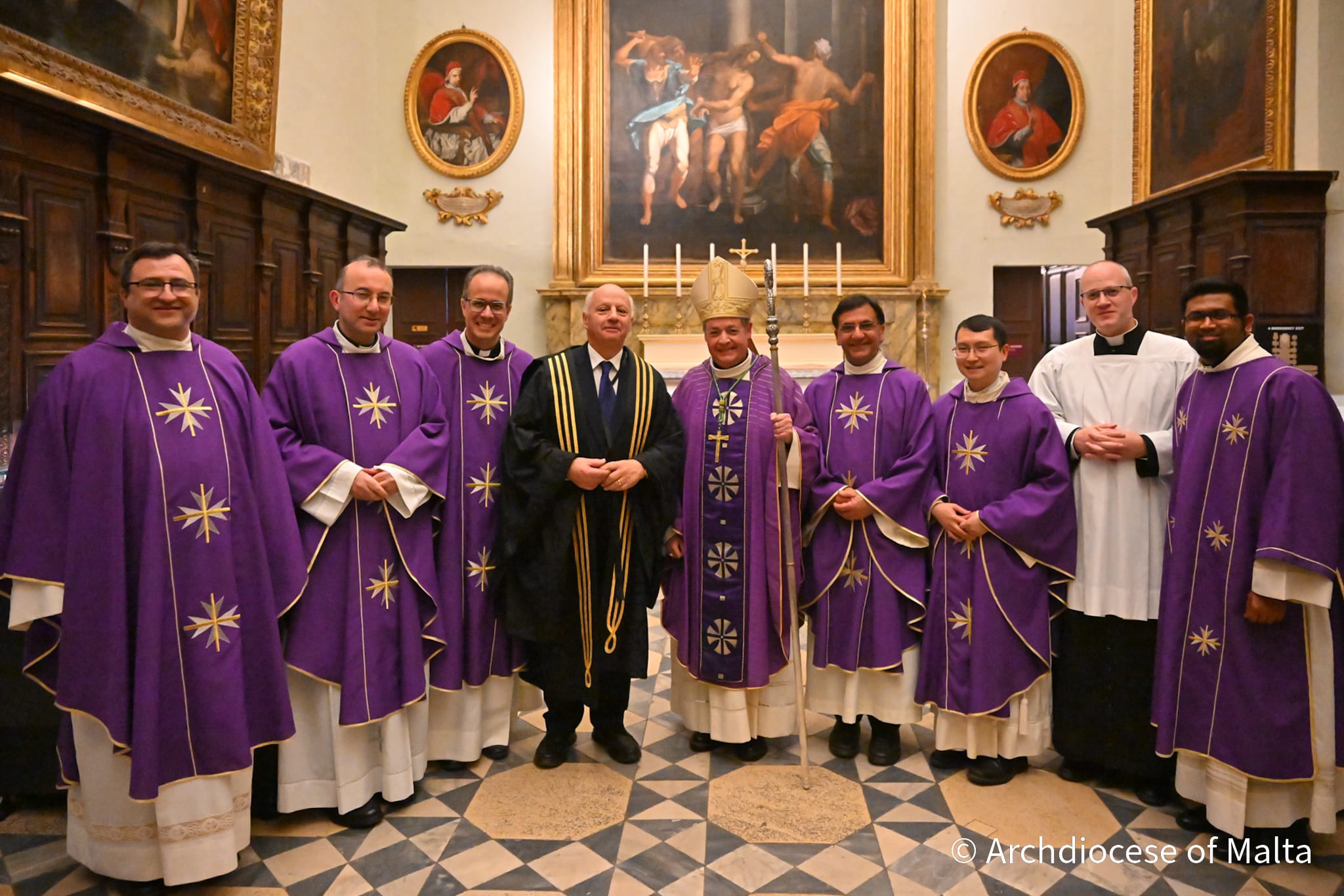





Homily by Bishop Joseph Galea-Curmi
“It asks for a sign” (Lk 11:29). In today’s Gospel, Jesus addresses a crowd that is searching for a sign. The crowd wants something spectacular, something that creates excitement, something extraordinary. However, Jesus tells them that no sign will be given to them except “the sign of Jonah.”
Jesus says that the people of Nineveh “repented at the preaching of Jonah” (Lk 11:32). The Queen of the South travelled from afar “to listen to the wisdom of Solomon” (Lk 11:31). And Jesus concludes with a powerful statement, which he repeats twice: “Behold, something greater is here” (Lk 11:31–32).
Today, as you celebrate your graduation, you rejoice in various signs, visible marks of success: a degree, a title, an academic distinction, professional recognition. These are beautiful and fitting achievements, and I wish to congratulate you wholeheartedly for this success. Together with you, I give thanks to God and to all those who supported you throughout the years: your families, your educators and members of the University staff who assisted you in your studies, as well as your friends and others close to you.
Your graduation does not simply produce a document; it is the fruit of years of intellectual discipline, sacrifice, perseverance, and growth in maturity. The Gospel gently reminds us: the most important signs are not those that create a spectacle. The most powerful sign is the life you will live as you now exercise your profession. Allow me to mention a number of signs.

The Sign of Honesty
As postgraduate students, you have engaged in serious research, critical thinking, and meticulous analysis. You have learned to ask questions, to evaluate evidence, to argue responsibly.
In a world where false information spreads quickly and superficiality often prevails, your formation calls you to something truly profound: honesty.
The people of Nineveh listened to Jonah and changed their lives. They were open to the truth, even when it was uncomfortable. Academic life teaches us that truth is not always convenient, but it is always liberating.
Honesty is not merely about avoiding academic misconduct. It is intellectual humility. It is resisting the temptation to manipulate data for personal gain. It is refusing to distort reality for the sake of convenience. A society built on half-truths and selective narratives eventually damages both people and itself. A society built on an honest search for truth remains firm.
You are now called to be guardians of the truth and humble seekers of it, not promoters of what is fake.

The Sign of Integrity
Jesus criticises the crowd because they seek spectacle without conversion. They want signs without inner change.
You are called to integrity, which means that knowledge and character must walk together. The word ‘integrity’ comes from the Latin integer, meaning ‘whole’. Integrity is wholeness – when who you are in private matches who you appear to be in public.
In professional life, you may face pressures: to cut corners, to compromise values, to prefer personal advancement over conscience. Integrity will sometimes come at a cost. It may cost opportunities, promotions, or popularity. But without integrity, success becomes hollow.
Jesus says that the Queen of the South travelled far in search of wisdom. Today society thirsts for professionals and leaders of integrity, people who can be trusted. Your qualification gives you competence; integrity will give you credibility.

The Sign of Creativity
Jesus says: “Behold, something greater than Solomon is here” (Luke 11:31). Solomon symbolises wisdom. But wisdom is not static knowledge. It is creative understanding applied to concrete human situations.
Your studies have given you specialised expertise. But our world does not need experts enclosed in narrow silos or ivory towers. It needs creative thinkers: women and men capable of building bridges between disciplines, cultures, and generations.
Creativity is not merely artistic talent. It is the courage to design solutions where others see only problems. It is innovation guided by ethics. It is research animated by compassion.
In a time of rapid technological transformation, of artificial intelligence, and in a context of environmental crisis and social fragmentation, creativity must be anchored in human dignity. Knowledge without creativity stagnates. Creativity without ethics can destroy. You are called to unite both creativity and ethics.

The Sign of Service
The Gospel shifts our focus: from seeking signs to becoming signs. The people of Nineveh changed because Jonah went to them. The Queen of the South travelled to seek wisdom. In both stories there is movement, an outward journey. Your graduation is not an end. It is a mission.
Higher education is a blessing. There are many in the world who have not had, or are denied, the opportunities that you have had, and these inequalities have increased due to wars and difficult conditions for many. I encourage you not just to ask: “What will I achieve?” but also: “How can I truly serve with what I have gained?”
Service does not diminish healthy ambition; it purifies it.
Whatever your field, you are called to build structures that protect the vulnerable, promote justice, encourage solidarity, and strengthen community. The true measure of your success is not the recognition you receive, but the lives that are improved because you cared for them.

Become the Sign
Jesus says that the people of Nineveh and the Queen of the South will rise in judgment because they responded to what was given to them. Much has been given to you: intellectual formation, analytical tools, critical awareness, a broader vision. To whom much is given, much is required.
In our society you will encounter realities of polarisation, corruption, greed, inequality, environmental degradation, and erosion of trust. Academic excellence alone will not heal these wounds. But graduates with ethical conviction and hearts oriented toward service can make a difference.
My appeal to you is to fully recognise your responsibility. Be a sign of honesty in systems tempted by deception. Be a sign of integrity in environments prone to compromise. Be a sign of creative hope in times of discouragement. Be a sign of service in a world often centred on self. And may you, in your generation, become the living sign of what truly gives meaning to life.

✠ Joseph Galea-Curmi
Auxiliary Bishop of Malta