



A quiet but notable shift is under way within the Archdiocese of Malta, as a growing number of adults are requesting the Sacraments of Initiation – Baptism, Confirmation and the Eucharist – even as infant baptisms continue their gradual decline.
Figures obtained by Newsbook Malta from the Archdiocese of Malta point towards a changing landscape.
Between 2018 and 2021, the number of adults receiving the sacraments remained relatively low. In 2018, there were 20 adults, falling to 12 in 2019, rising again to 15 in 2020, before dropping to just eight in 2021. It should be noted that 2020 and 2021 were the years when the country was severely affected by the Covid-19 pandemic.
However, from 2022 onwards, a clear increase has emerged.
| Year | Adults |
|---|---|
| 2022 | 27 |
| 2023 | 34 |
| 2024 | 15 |
| 2025 | 20 |
| 2026 | 36 |
In 2024, a further 23 adults requested to receive Confirmation, while in 2025, 37 made such a request.
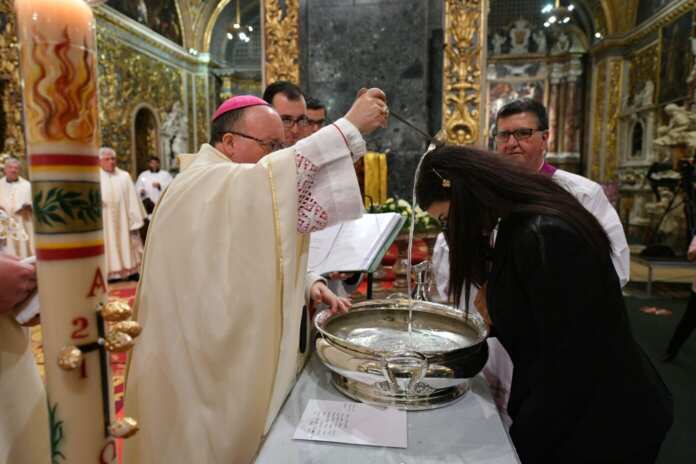
During this year’s Easter Vigil, 36 adults received the sacraments of initiation across two separate celebrations – one at St John’s Co-Cathedral presided over by Archbishop Charles Scicluna, and the other at Mdina Cathedral led by Auxiliary Bishop Joseph Galea Curmi.
Should the trend hold, 2026 may well prove a record year for adult initiations in Malta.
Stronger effect in other European nations
In other European countries, this phenomenon of “awakening” appears to be taking place with even greater intensity.
In the Diocese of Southwark in England, more than 590 adults were received into the Church this year, representing the highest number of converts to Catholicism. They came from 112 different parishes, with half of the candidates under the age of 35 and a significant number under 30.
Meanwhile, France has also reported a considerable increase. This year, more than 13,200 adults were baptised during the Easter Vigil as part of a total of over 20,000 catechumens. This represents an increase of approximately 20 per cent on the previous year and a staggering rise of nearly 390 per cent compared with a decade ago.
A survey conducted in France found that many catechumens – those requesting the Sacraments of Initiation – said their desire to receive the sacraments stemmed from personal experiences of suffering, the death of a loved one, or as the fruit of a spiritual search.
What is happening in Malta?
While numbers have no bearing on the relevance of faith or the Church, these developments in Malta suggest that despite a decline in traditional religious practice, a new and more conscious interest in the faith is emerging among adults.
The figures provided by the Archdiocese’s Curia regarding infant baptisms tell a different story.
After 2018 and 2019, when more than 3,000 infants were baptised, in 2020 some 998 babies aged up to one year received the sacrament. In the same year, 1,231 children aged between one and seven were also baptised.
Due to the pandemic, baptisms were interrupted for several months, leading to a total of 3,677 infant baptisms in 2021, together with 50 baptisms of children aged between one and seven.
From 2021 onwards, the Church in Malta has witnessed a considerable reduction in the number of baptisms of infants up to one year of age. Whereas previously the number exceeded 3,000, it has now fallen to around 2,600 or fewer.
| Year | Baptisms (0-1 year) |
|---|---|
| 2022 | 2,613 |
| 2023 | 2,682 |
| 2024 | 2,534 |
| 2025 | N/A |
Falling birth rates, together with social and cultural changes, may be contributing to this development, with infant baptism no longer viewed as an automatic step.
Interestingly, between 2022 and 2024, the number of baptisms for children aged between one and seven, as well as for those over seven, was considerably higher than in previous years.
| Year | Baptism (1-7 years) | Baptism (7 years +) |
|---|---|---|
| 2018 | 12 | 13 |
| 2019 | 12 | 13 |
| 2020 | 1,231 (Covid-19) | 20 |
| 2021 | 50 | 10 |
| 2022 | 188 | 34 |
| 2023 | 187 | 39 |
| 2024 | 226 | 31 |
| 2025 | N/A | N/A |
First Communion and Confirmation still sought?
Regarding First Communion and Confirmation, the figures remain relatively stable, with approximately 3,000 to 3,500 children receiving these sacraments each year, aside from pandemic-related fluctuations.
This suggests that the traditional system of religious education continues to function, even as the social context changes.
Overall, the situation in Malta appears to reflect realities also seen elsewhere in Europe: a decline in traditional religious practice, alongside a small but significant rise in those who embrace the faith as a conscious, personal choice.
While it remains too early to speak of a “religious revival” in any broad sense, the figures indicate a clear shift in dynamics – from a religion that was once part of society’s automatic cultural fabric to one increasingly becoming a matter of individual choice.
This may signal a new phase in the life of the Church in Malta – one that, though smaller in numbers, may prove more convicted in its practice.
Source: Newsbook.com.mt
Article written by Jurgen Balzan