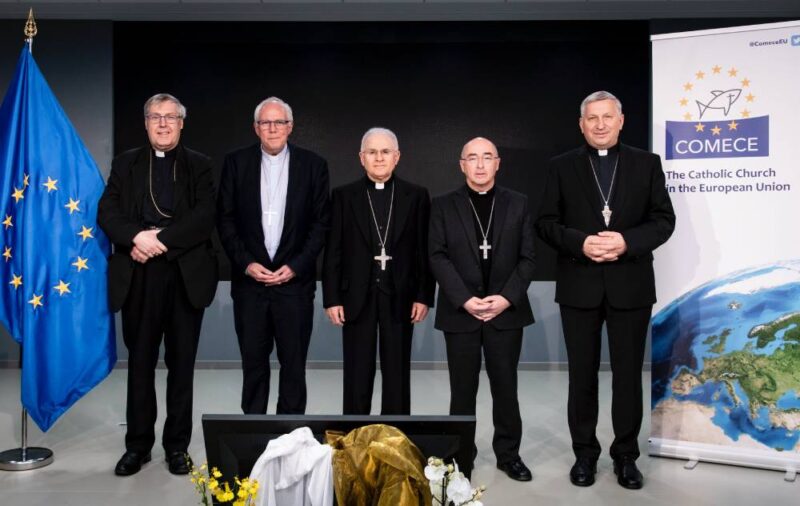





In a statement released on Wednesday, 4 March 2026, the Presidency of the Commission of the Bishops’ Conferences of the European Union (COMECE) welcomes the decision of the European Commission not to establish a new funding programme as requested by the citizens’ initiative ‘My Voice, My Choice’. The bishops of the EU, however, express concerns over the possibility of mobilising the existing European Social Fund Plus to provide cross-border abortion services
Statement by COMECE
The Presidency of COMECE welcomes the decision of the European Commission not to submit a proposal to the European Parliament and the Council for a legal act establishing a new funding programme, as requested by the European Citizens’ Initiative (ECI) “My Voice, My Choice” and supported by the Parliament. This decision clearly recognises the need to respect the limits of EU competences and to uphold the principle of subsidiarity.
At the same time, COMECE expresses serious concern that the Commission explicitly states that EU funds may be used to provide cross-border “access to legally available, safe and affordable abortion services.” The Commission refers in particular to the possibility of mobilising the existing European Social Fund Plus (ESF+) through amendments to national or regional programmes.
The ESF+ was originally designed to promote social inclusion, support employment, and prevent families — especially those with children — from falling into poverty. Redirecting this financial instrument towards the financing of abortions, including potentially for women travelling from Member States where access is more restricted, departs from its original purpose and risks creating political friction rather than strengthening cohesion. Such an approach does not represent genuine support for women in vulnerable situations. On the contrary, what vulnerable women need — across all regions of the Union — is effective social, economic, and healthcare assistance enabling them to carry their pregnancy to term without suffering negative social or economic consequences for themselves or for their child.
At the level of principles and values, which must always guide political action and EU policies, COMECE reiterates the following:
Direct abortion — that is, abortion willed either as an end or as a means — is gravely contrary to the moral law. This has been the constant teaching of the Catholic Church. Scientific research increasingly confirms that from fertilisation a new human being comes into existence, endowed with inherent dignity and deserving of the fundamental protection owed to every human life.
COMECE reiterates that what Europe truly needs — if it is to remain faithful to its foundational values of human dignity, solidarity, and equality — is concrete and sustained support for women in vulnerable situations. Women must be genuinely helped to welcome motherhood and should never feel compelled to abort due to social or economic pressure. Policies that strengthen maternity protection, family support, and social inclusion are those that truly promote women’s dignity and foster cohesion across the Union.
Finally, we firmly urge that matters touching upon the inherent dignity of the human person, the fundamental right to life, and the protection of the most vulnerable must never be instrumentalised in political debate or exploited for ideological purposes.
Source: comece.eu