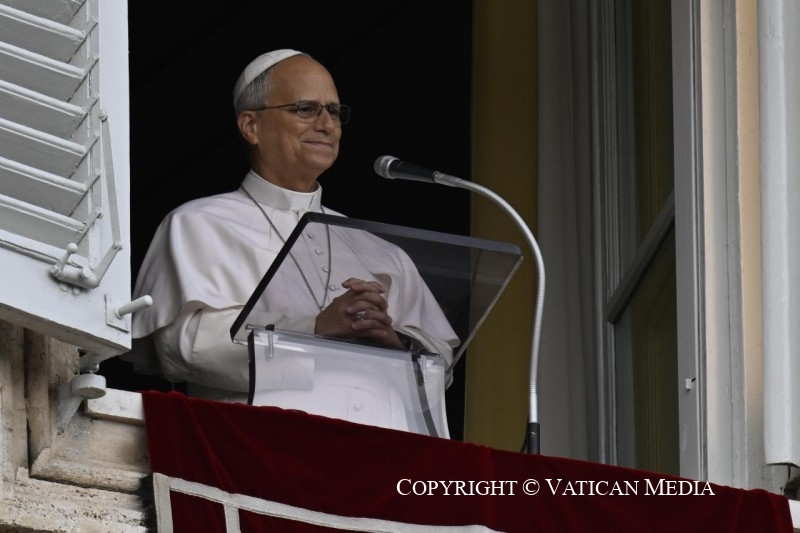




Dear brothers and sisters, happy Sunday!
The Gospel proclaimed in today’s liturgy (Mt 22:15-21) presents us with one of Jesus’ best-known sayings: “Give therefore to the emperor the things that are the emperor’s, and to God the things that are God’s” (cf. v. 21). For this reason, it is important to consider these words in the context in which they were originally spoken.
The evangelist Matthew describes a situation of hostility towards Jesus: the Pharisees gather together to see how they might catch him in his words (cf. v. 15). They decide to send some people to question him on a controversial matter: “Is it lawful to pay taxes to the emperor, or not?” (v. 17). The Teacher’s response is astute, for it allows him to avoid the trap and exposes the hypocrisy of those who seek to put him to the test. He asks them to show him the coin used to pay the tax, that is, a denarius. They hand it to him, and Jesus asks: “Whose head is this, and whose title?” They reply: “The emperor’s.” He then declares: “Give therefore to the emperor the things that are the emperor’s, and to God the things that are God’s” (vv. 17-21).

In Jesus, we contemplate a God who is not afraid of history but comes instead to dwell within it. His Kingdom does not abolish human roles and responsibilities. It does, however, call us to live without compromise, free from selfish ambitions and unjust motives, seeking above all the Kingdom of God and his righteousness (cf. Mt 6:33). In this regard, it is striking that those same people praise Jesus, even though their intentions are far from good: “Teacher, we know that you are sincere, and teach the way of God in accordance with truth, and show deference to no one; for you do not regard people with partiality” (v. 16).
Dear friends, this is precisely what it means to “give to the emperor the things that are the emperor’s, and to God the things that are God’s”: to be truthful, free from servile fear or hypocrisy, free to do good. Let us pray to the Lord to help us live in this way. And let us entrust ourselves to the intercession of the Virgin Mary.
Source: vatican.va