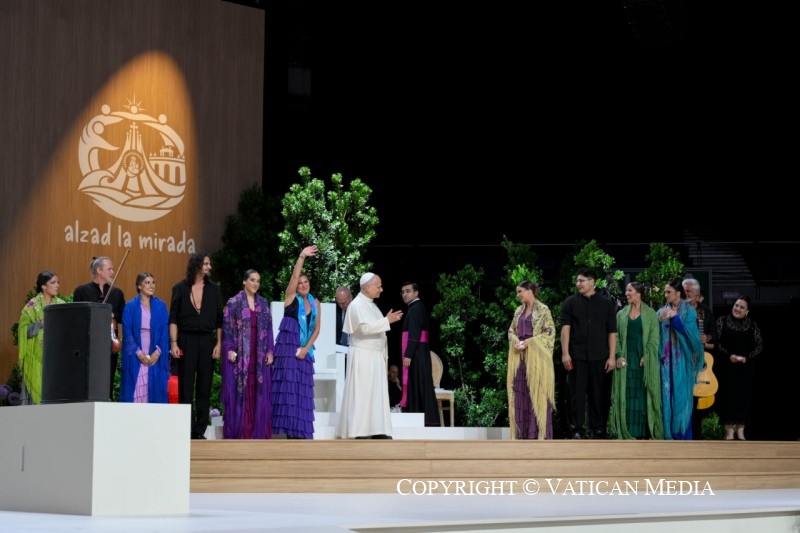




Address by Pope Leo XIV
Your Eminence,
Dear friends,
It is a pleasure to be with you in this place that not only welcomes sporting, artistic and cultural events, but also the deepest emotions of human beings: joy, admiration, enthusiasm and hope, as well as sadness and frustration.
In this beautiful country it is impossible not to admire the creative spirit that runs through its history and shapes its identity. A beauty that is evident in its cities, in its streets, its monuments, in its squares and gardens, in its universities and churches, its music, painting, dance, and in its cuisine. Here, too, one senses the spirit of the generations who transformed the landscape and gave it a character of its own, and this reveals to us, in every detail, the intelligence and determination that dwell in the human spirit.
After carefully considering these wonders created by previous generations, a question inevitably arises that challenges us all: what legacy are we leaving for the future and, by extension, what kind of community are we building?
I have listened intently to each of the panelists’ contributions, and I agree with you. Our society does indeed possess an extraordinary capacity to produce, innovate and communicate; however, it seems we still need to learn how to safeguard the soul of what it generates. Otherwise, we run the risk of becoming experts in the media and effective producers, yet uncertain as to why, for what purpose, with whom and for whom we produce. In this context, the Church, mindful of both its successes and its errors throughout history, longs to remain in dialogue with the contemporary world.
The desire for goodness, beauty and truth is rooted in the very DNA of humanity. It is on the basis of this profoundly human aspiration and our centuries-old experience that the Church proposes paths toward a life of dignity and the common good. In this regard, Saint Paul VI affirmed before the United Nations that, whatever one’s opinion of the Roman Pontiff may be, his mission is well known. As an “expert in humanity,” the Church does not turn a blind eye to anything truly human (cf. Gaudium et Spes, 1). For this reason, “openness to dialogue is an integral part of the Church’s vocation” (Magnifica Humanitas, 2). Today we confirm that the decisive question remains the same: what does it mean to be truly human?

With humility and conviction, the Church shares what she has discovered through the experience of faith: that Jesus Christ provides the answer to the great questions concerning human life and its fulfilment, both in this world and ultimately in eternity. “For this reason, the human person always remains the ‘way for the Church’ and the heart of every authentic path of integral human development” (ibid., 50). Therefore, the Church cannot turn a blind eye to culture, because through it, man as man “is” more fully human (cf. Compendium of the Social Doctrine of the Church, 554).
Precisely since “culture” calls to mind “cultivate,” just as the etymological roots that both words share suggest, we are rightly called to ask ourselves what it is that we are sowing today, what exactly is flourishing and what is silently withering in our society; what values are we preserving and which are we allowing to die. These are profound and necessary questions that cannot be ignored.
In order to address these questions, it is necessary to have a social dialogue that can be likened to the art of building networks, which involves coming together, listening, dialogue and respect.
In the various spheres of human activity, we must be mindful of the language we use — whether written, spoken or imagery in the digital realm — because communication is never neutral. Every form of expression speaks and conveys meaning; it can wound or heal, shatter expectations or open new horizons, sow division or awaken hope in the possibility of building something genuinely human together.
Thus, building networks is a dialogue among institutions which is centered on human dignity. This entails, for example, that the university not ignore the working world nor renounce the truth; that business not view the employee as just another factor in the equation of its interests. That art not be intended solely for the elites; that sports not be reduced to a spectacle or turned into mere business; and that technological progress take into account the elderly, the poor and those without a voice.

From a Christian perspective, our contribution to the dialogue concerning life recognizes that the Creator has woven human beings with threads of love; for they have been created in the image and likeness of God, God is love (cf. 1 Jn 4:8). Herein lies the foundation of inalienable human dignity, the absolute respect of which is the basis of dialogue.
Second, building networks means creating together. “Faith,” Pope Benedict XVI affirmed, “is love, and therefore creates poetry and music. Faith is joy, therefore it creates beauty” (Catechesis, 21 May 2008). We have all experienced something beautiful — so much so that it changed us from within: a song, a poem, a quiet church, a voice, a glance, or even a basketball game enjoyed with friends.
It is no wonder, then, that the proclamation of the Good News and the awareness that we are all brothers and sisters finds expression in the form of a saeta during Holy Week or in mystical poetry. Expression can also be found in the literary genius of authors such as Lope de Vega, Saint Teresa of Ávila, Saint John of the Cross, Calderón de la Barca, or in the serene prose of Saint Thomas Aquinas, from whom we have inherited the beautiful hymns of Corpus Christi, which we celebrate today. All of this reveals the bond between the material and the spiritual that constitutes our existence.
Third, building networks means to serve selflessly. An objective view reveals that men and women, moved by faith, have built hospitals and schools, begun initiatives of solidarity and spoken with a language that adorns people with dignity. For this reason we would do well to ask ourselves honestly if the world — and Europe in particular — would have forged its identity without that spiritual influence that has permeated its history. This is not meant to be provocative, but rather an invitation to consider whether eternity — which burst into time and space through the incarnation of Jesus Christ — can still be reconciled with everyday life.
Is it seriously possible to believe that Europe — which we deeply love — would be the same without the influence of faith? Why should we fear that eternity permeate everyday life? The cry of my predecessors lives on: do not be afraid! Open wide the doors to Christ! Jesus Christ takes nothing from us and gives us everything.

I ask myself: Who are the ones being excluded despite their virtues and abilities? We cannot ignore the fact that the condition of the poor is a cry that, in the history of humanity, constantly challenges our lives, our societies, our political and economic systems, and the Church (cf. Dilexi Te, 9).
Indeed, Christ restores the common good to its rightful place as a wise arbiter who tempers the greed of some and nourishes the hope of others, while longing to save them all.
This Church, “an expert in humanity,” although at times going against the tide, insists that the “economic and institutional structures are just only to the extent that they serve the integral development of the person and promote the responsible participation of all” (Magnifica Humanitas, 34).
Finally, let me draw your attention to a world that, as you know, is no stranger to me: the world of sports. Consider how many of us learned to respect our opponents on the field rather than by listening to a lecture. How many athletes teach us to lose without hatred, to win without humiliating others, or to get back up after falling.
Saint John Paul II, as an athlete and pastor, once said: “In these times when, unfortunately, various forms of violence — and thus of hatred — tend to tear apart the fabric of social solidarity, you [athletes] play your part in offering a shining example of cohesion, peace, and unity — in a word, of ‘knowing how to be together’” (Address to the Participants in the 33rd Europe, Africa and Mediterranean Waterskiing Championships, 31 August 1979). These words are even more relevant and timely now than when they were first spoken.
Dear friends: I invite you, then, to be new protagonists for weaving new networks that harmonize all areas of life. To weave a renewed society where time is imbued with eternity, culture safeguards memory and fosters dialogue, education promotes the search for truth with a critical spirit, art awakens wonder and generates noble emotions, business recognizes the dignity of the person, and work remains a source of hope.

Let us be new protagonists by heeding Saint Paul’s counsel: “Rejoice with those who rejoice, weep with those who weep. Live in harmony with one another; do not be haughty, but associate with the lowly; do not claim to be wiser than you are. Do not repay anyone evil for evil, but take thought for what is noble in the sight of all. If it is possible, so far as it depends on you, live peaceably with all” (Rom 12:15–18). For all this determines whether, in the future, our “humanity in all its grandeur” will continue to shine forth. Thank you very much.
Let us all, then, be builders of this new community.
Thank you very much, and best wishes to everyone.
Source: vatican.va