



Homily of Pope Leo XIV
Dear brothers and sisters,
In one of the Scripture passages we have just heard, the Apostle Paul refers to himself as “the least of the apostles” (1 Cor 15:9). He considers himself unworthy of this title because he had once been a persecutor of the Church of God. Nevertheless, he is not a prisoner of that past, but rather a “prisoner in the Lord” (Eph 4:1). It was indeed by the grace of God that Paul came to know the risen Lord Jesus, who revealed himself first to Peter, then to the other Apostles and to hundreds of other followers of the Way, and finally also to him, a persecutor (cf. 1 Cor 15:3-8). His encounter with the risen Lord brought about the conversion that we commemorate today.
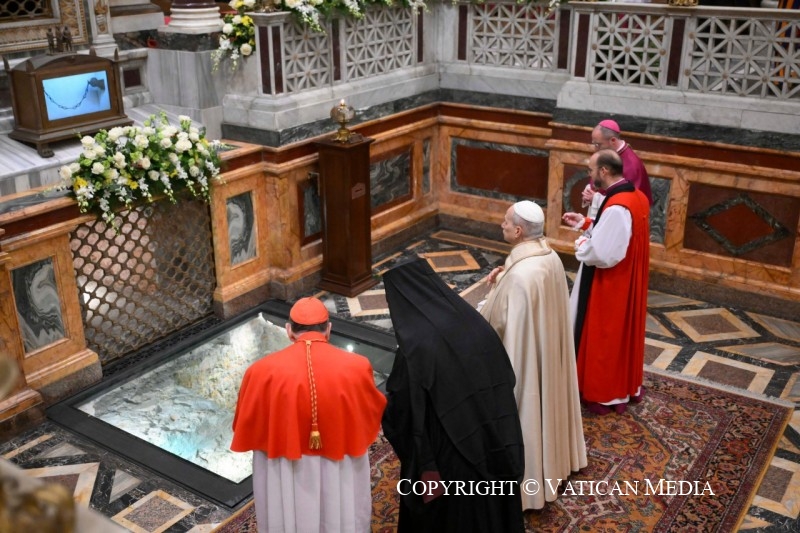
The depth of this conversion is reflected in the change of his name from Saul to Paul. By the grace of God, the one who once persecuted Jesus has been completely transformed into his witness. The one who once fiercely opposed the name of Christ now preaches his love with burning zeal, as vividly expressed in the hymn we sang at the beginning of this celebration (cfr. Excelsam Pauli Gloriam, v. 2). As we gather before the mortal remains of the Apostle to the Gentiles, we are reminded that his mission is also the mission of all Christians today: to proclaim Christ and to invite everyone to place their trust in him. Every authentic encounter with the Lord is, in fact, a transformative moment that grants a new vision and a new direction for the task of building up the Body of Christ (cf. Eph 4:12).

The Second Vatican Council, in the beginning of its Constitution on the Church, expressed its ardent desire to proclaim the Gospel to all creation (cf. Mk 16:15) and so “bring to all humanity that light of Christ which is resplendent on the face of the Church” (Lumen Gentium, 1). It is the shared task of all Christians to say humbly and joyfully to the world: “Look to Christ! Come closer to him! Welcome his word that enlightens and consoles!” (Homily of the Mass for the Beginning of the Pontificate of Pope Leo XIV 18 May 2025). My dear friends, every year the Week of Prayer for Christian Unity invites us to renew our commitment to this great mission, bearing in mind that the divisions among us – while they do not prevent the light of Christ from shining – nonetheless make the face which must reflect it to the world less radiant.
Last year, we celebrated the 1700th anniversary of the Council of Nicaea. His Holiness Bartholomew, Ecumenical Patriarch, invited us to celebrate the anniversary in İznik, and I give thanks to God that so many Christian traditions were represented at that commemoration two months ago. Reciting the Nicene Creed together in the very place where it was formulated was a profound and unforgettable testimony to our unity in Christ. That moment of fraternity also allowed us to praise the Lord for what he accomplished through the Nicene Fathers, helping them to express clearly the truth of a God who drew near to us in Jesus Christ. May the Holy Spirit find in us docile minds even today, so that we may proclaim the faith with one voice to the men and women of our time!

In the passage from the Letter to the Ephesians chosen as the theme for this year’s Week of Prayer, we repeatedly hear the adjective “one”: one body, one Spirit, one hope, one Lord, one faith, one baptism, one God (cf. Eph 4:4-6). Dear brothers and sisters, how can these inspired words not touch us deeply? How can our hearts not burn within us when we hear them? Yes, “we share the same faith in the one and only God, the Father of all people; we confess together the one Lord and true Son of God, Jesus Christ, and the one Holy Spirit, who inspires us and impels us towards full unity and the common witness to the Gospel” (Apostolic Letter In Unitate Fidei, 23 November 2025, 12). We are one! We already are! Let us recognize it, experience it and make it visible!
My dear predecessor, Pope Francis, remarked that the synodal journey of the Catholic Church “is and must be ecumenical, just as the ecumenical journey is synodal” (Address to His Holiness Mar Awa III, 19 November 2022). This was reflected in the two Assemblies of the Synod of Bishops in 2023 and 2024, marked by deep ecumenical zeal and enriched by the participation of numerous fraternal delegates. I believe this is a path for growing together in mutual knowledge of our respective synodal structures and traditions. As we look toward the 2,000th anniversary of the Passion, Death and Resurrection of the Lord Jesus in 2033, let us commit ourselves to further developing ecumenical synodal practices and to sharing with one another who we are, what we do and what we teach (cf. Francis, For a Synodal Church, 24 November 2024, 137-138).

Dear friends, as the Week of Prayer for Christian Unity draws to a close, I extend cordial greetings to Cardinal Kurt Koch, to the members, consultors and staff of the Dicastery for Promoting Christian Unity, and to the members of the theological dialogues and other initiatives promoted by the Dicastery. I am grateful for the presence at this Liturgy of numerous leaders and representatives of the various Churches and Christian Communions worldwide, in particular Metropolitan Polykarpos, representing the Ecumenical Patriarchate, Archbishop Khajag Barsamian, from the Armenian Apostolic Church, and Bishop Anthony Ball, on behalf of the Anglican Communion. I also greet the scholarship students of the Committee for Cultural Collaboration with the Orthodox and the Oriental Orthodox Churches from the Dicastery for Promoting Christian Unity, the students of the Bossey Ecumenical Institute of the World Council of Churches, as well as the ecumenical groups and pilgrims participating in this celebration.
The materials for this year’s Week of Prayer for Christian Unity were prepared by the Churches in Armenia. With deep gratitude, we remember the courageous Christian witness of the Armenian people throughout history, a history in which martyrdom has been a constant feature. As we conclude this Week of Prayer, we honor the memory of Catholicos Saint Nersès Šnorhali “the Gracious,” the holy Catholicos who worked for the unity of the Church in the 12th century. He was ahead of his time in understanding that the search for unity is a task entrusted to all the faithful, and that it requires the healing of memory. As my venerable predecessor Saint John Paul II recalled, Saint Nerses also teaches us the attitude we should adopt on our ecumenical journey: “Christians must have a profound interior conviction that unity is essential, not for strategic advantage or political gain but for the sake of preaching the Gospel” (Homily at the Ecumenical Celebration, 26 September 2001).

According to tradition, Armenia was the first Christian nation, after King Tiridates was baptized by Saint Gregory the Illuminator in the year 301. We give thanks for the intrepid heralds of the saving Word who spread the faith in Jesus Christ throughout Eastern and Western Europe. We pray that the seeds of the Gospel may continue to bear fruit on this continent in unity, justice and holiness, for the benefit of peace among the peoples and nations of the whole world.
Source: vatican.va