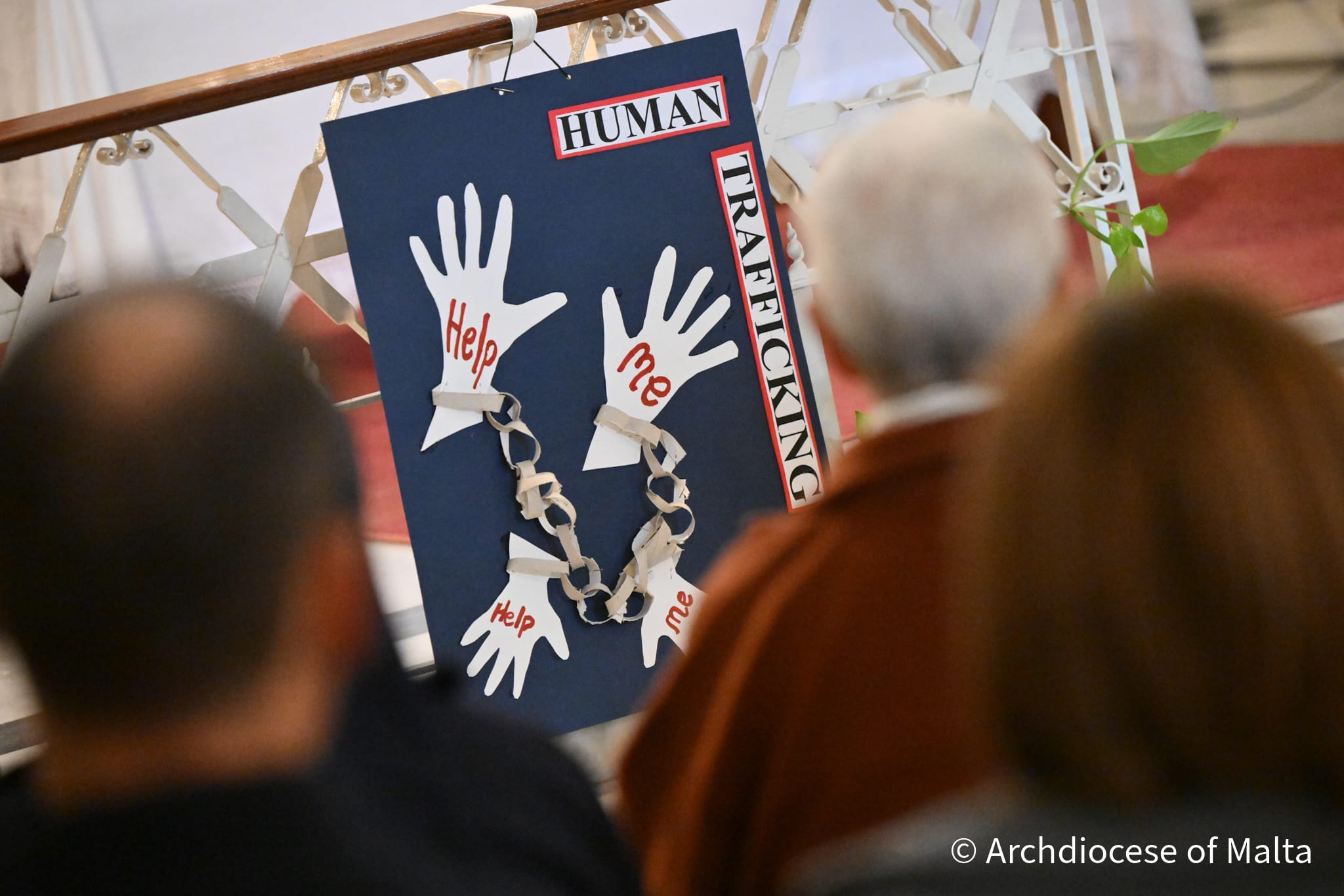





Homily by Bishop Joseph Galea-Curmi
The Word of God we have heard today leaves us with no room for indifference. Through the prophet Isaiah, God speaks clearly and forcefully about the kind of worship that truly pleases him: “Share your bread with the hungry, shelter the oppressed and the homeless, clothe the naked when you see them, and do not turn your back on your own” (Isaiah 58:7).
God’s dream for human dignity
This is not poetic exaggeration. It is God’s dream for humanity. A world where no one is treated as disposable. A society where the vulnerable are not hidden, exploited, or silenced.
Human trafficking is a direct contradiction of this dream. It is one of the most brutal violations of human dignity in our time: where men, women, and children are reduced to commodities; where bodies are bought and sold; where freedom is stolen and hope is crushed. As Pope Leo XIV has said in his message marking the 12th World Day against Human Trafficking: it is “a grave crime against humanity”.
And the tragedy is that this crime often thrives in darkness, silence, and indifference.

A sin that cries out to Heaven
Human trafficking is not only a social problem. It is not only a political failure. It is a grave sin, because it strikes at the heart of the human person created in the image of God.
Every trafficked person is bound by unjust chains. Every exploited life bears a yoke imposed by greed, violence, and deception. And God says clearly: This must be broken. The Church cannot remain neutral. Faith that does not respond to suffering becomes empty ritual. Prayer that does not lead to action becomes just noise.
Salt and Light
In the Gospel, Jesus tells us: “You are the salt of the earth… You are the light of the world” (Matthew 5:13.14). Salt preserves, gives flavour, and prevents decay. Light reveals what is hidden and guides those who walk in darkness.
In the face of human trafficking, these words become a mission. To be salt means refusing to let society rot in indifference. To be light means exposing systems of exploitation, even when it is uncomfortable. Silence protects the trafficker. Darkness shelters abuse. But the light of Christ reveals the truth and restores dignity.
The Church is not called to blend in, but to stand out. Not to dim the light, but to place it “on a lampstand” (Matthew 5:15).

Compassion that moves to action
Isaiah gives us a powerful promise: “Then your light shall break forth like the dawn… Then you shall call, and the Lord will answer” (Matthew 58:8.9). Notice the order: action comes first. Justice opens the way for blessing. Mercy unleashes healing.
This is why the work of the Diocesan Commission for Justice and Peace and the Sisters of the Good Shepherd, and all those involved in this ministry, who are creating awareness on human trafficking, is not optional charity; it is Gospel in action.
Today, we pray for the intercession of Saint Josephine Bakhita, the Sudanese-born Canossian nun and the first female Black Catholic saint of the modern era. When still young, she was kidnapped by slave traders and sold several times. She found freedom in Italy, and is now the patron saint of victims of slavery. She is “a powerful witness of hope in the Lord who loved her to the end” (Leo XIV). Saint Josephine reminds us that Christ goes in search of those who have been pushed to the margins, especially women and girls wounded by violence, exploitation, and abandonment.
She is an inspiration to all those working against human trafficking. Their
presence tells survivors: You are seen. You are believed. You are not alone. This
is what it means to let our light shine: not to draw attention to ourselves,
but to reflect the face of Christ.

Our Christian Response
Dear brothers and sisters, the question today is not: Is human trafficking happening? We know it is, and it is widespread. The question is: What will we do about it?
Our response must be concrete. Today’s celebration has a special call to us all:
- Be aware – refusing to look away, educating ourselves, breaking the silence.
- Be vigilant – recognising signs of exploitation in our communities, signs which, at times, may be hidden.
- Be compassionate – supporting survivors with respect, patience, and care.
- Be prophetic – challenging systems that profit from human suffering.
- Be committed – through prayer, advocacy, and solidarity.
- Be united – create and strengthen networking between faith-based entities, voluntary groups, and the State.
Every small act matters. Every light, however small, pushes back the darkness.
Glorifying our Father
Jesus concludes: “Your light must shine before others, so that they may see your good deeds and glorify your heavenly Father” (Matthew 5:16).
When we defend the dignity of the victims of trafficking, when we stand with the exploited, when we work for justice and peace, we proclaim not only with words, but with our lives, that God’s Kingdom is already breaking into this world.
Pope Leo XIV encourages us to turn to prayer and awareness when facing these grave challenges today: “Prayer is the ‘small flame’ that we must guard amidst the storm, as it gives us the strength to resist indifference to injustice. Awareness enables us to identify the hidden mechanisms of exploitation in our neighbourhoods and in digital spaces. Ultimately, the violence of human trafficking can be overcome only through a renewed vision that beholds every individual as a beloved child of God”.

Today, we express our gratitude to everyone who serves as the hands of Christ by reaching out to victims of trafficking. May the Lord bless them for their courage, fidelity and tireless commitment. May this Eucharist strengthen us all to become salt that preserves hope, light that exposes injustice, and witnesses of a love that refuses to abandon the wounded. And may the Lord grant us the courage to ensure that no human life is ever treated as disposable, but always recognised as sacred.
✠ Joseph Galea-Curmi
Auxiliary Bishop of Malta