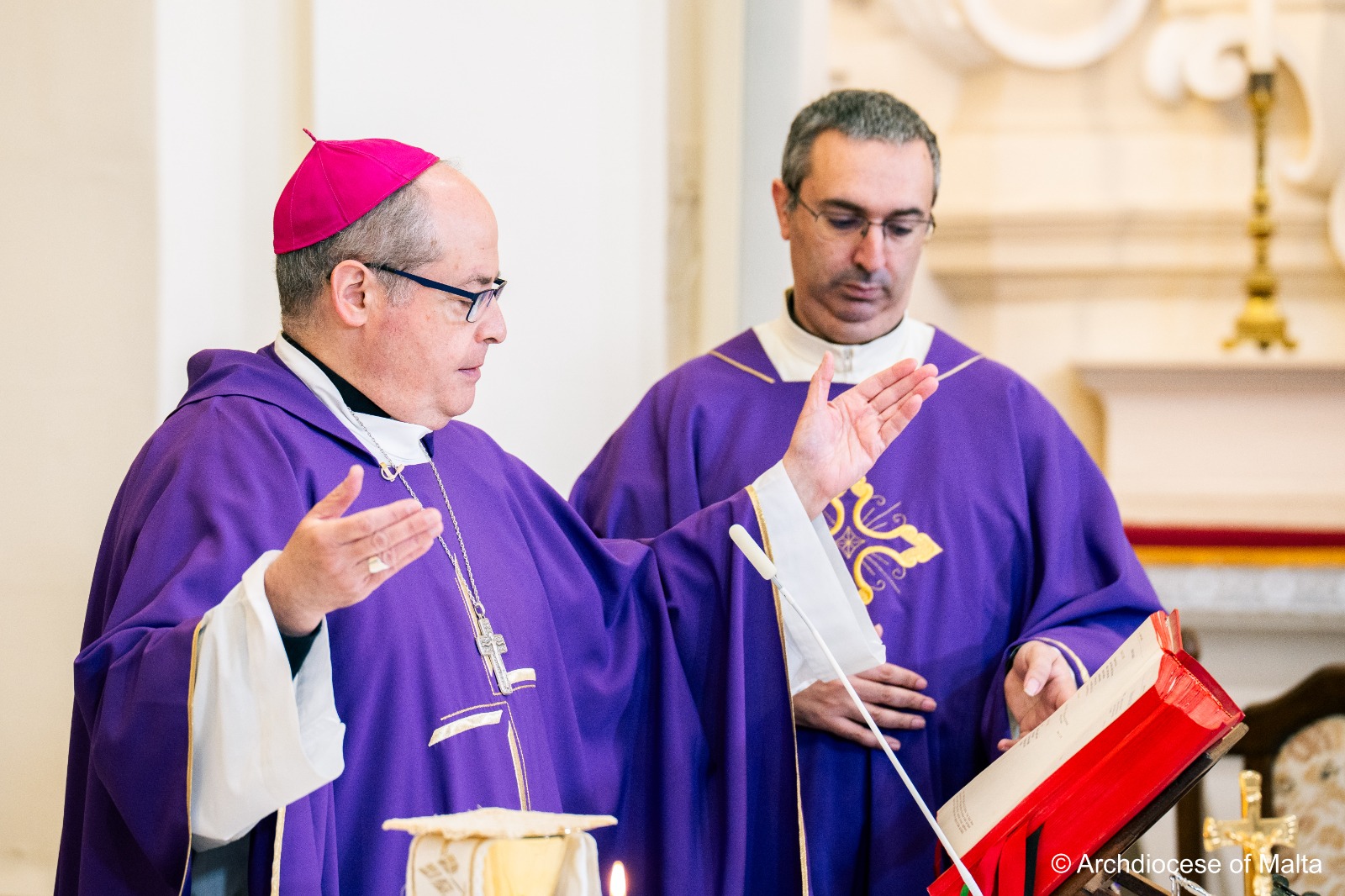





Homily by Bishop Joseph Galea-Curmi
Today’s Gospel presents one of the most powerful moments in the ministry of Jesus: the raising of Lazarus. It is not only a miracle story. It is a revelation of who Jesus is and what he has come to do. At the heart of this Gospel stands the great declaration of Jesus to Martha: “I am the Resurrection and the Life” (Jn 11:25).
This is the centre of the Christian faith. Jesus does not merely teach about resurrection. He does not only promise life. He is the Resurrection and the Life.
Today, this Gospel is proclaimed in a special way for those preparing to receive the Sacraments of Initiation at the Easter Vigil. The Church calls this moment a “scrutiny”. The word may sound severe, but its meaning is deeply hopeful. The Church, like a loving mother, asks Christ to look deeply into the hearts of those preparing for baptism, so that whatever is weak, wounded, or enslaved by sin may be healed and set free.
The scrutinies are not about judgment. They are about liberation. Just as Jesus called Lazarus out of the tomb, today he desires to call each catechumen out of whatever brings death to the soul.
Jesus enters our human pain
The Gospel begins with suffering. Lazarus is sick. His sisters, Martha and Mary, send word to Jesus. Yet Jesus does not come immediately. At first, this may seem strange. If Jesus loves them, why does he delay? But the Gospel reveals something deeper: God sometimes allows us to pass through darkness and, in this darkness, his glory is revealed and our faith may grow.
When Jesus finally arrives, Lazarus has already been dead for four days. The grief is real. Martha expresses both faith and sorrow: “Lord, if you had been here, my brother would not have died” (Jn 11:21). How often do we feel the same way in our lives: “Lord, where were you?”, “Lord, why did this happen?”, “Lord, why did you not come sooner?”
Yet the Gospel tells us something profoundly comforting: Jesus weeps. God is not distant from human suffering. God does not stand coldly before death. God enters into our tears. Jesus stands before the tomb and shares the pain of the human family.
The tombs in our lives
Before Jesus raises Lazarus, he commands something unexpected: “Take away the stone” (Jn 11:39). But Martha hesitates. The tomb has been closed for four days. The reality of death has already begun its work. This moment reveals something important about our spiritual life. Many times, we become accustomed to the “tombs” in our lives: habits of sin, fear, resentment, addictions, despair, wounds from the past. Sometimes we even believe these things are permanent. Like Martha, we say in our hearts: “Lord, it is too late.”
But Jesus does not accept that death has the last word. For you, catechumens preparing for baptism, this Gospel is a promise: no tomb is too sealed, no darkness too deep, no sin too powerful for Christ. Baptism is precisely this moment when Christ rolls away the stone and calls a person into new life.
“Lazarus, come out!”
After praying to the Father, Jesus cries out with a loud voice: “Lazarus, come out!” (Jn 11:43) This cry is more than a command. It is the voice of the Creator who calls life out of nothing. It is the same divine voice that spoke at the beginning of the world. And Lazarus emerges from the tomb, still wrapped in burial cloths, but alive. Then Jesus tells the people around him: “Untie him and let him go” (Jn 11:44).
This detail is beautiful. Jesus gives life, but the community helps remove the wrappings of death. This is also the role of the Church. Through prayer, encouragement, forgiveness, and love, the Christian community helps people live the freedom that Christ gives. For our catechumens, this means you are not walking this journey alone. The Church walks with you.
The meaning of the scrutiny
Dear catechumens, today the Church prays especially for you. The scrutiny asks Christ to do three things in your hearts:
1. To reveal what still needs healing; not to shame you, but to free you.
2. To strengthen what is good and holy within you, the seeds of faith that are already growing.
3. To prepare you for the new life of baptism.
Soon, during the Easter Vigil, you will pass through water and the Holy Spirit. Just as Lazarus emerged from the tomb, you will emerge from the waters of baptism as a new creation. Saint Paul describes it beautifully: we die with Christ so that we may rise with him.
A message for the whole Community
This Gospel is not only for the catechumens. It is also for all of us who have already been baptised. Because the truth is that even after baptism, we sometimes drift back toward the tombs: we grow lukewarm in faith, we carry grudges, we allow sin to bind us again. Today Jesus repeats his powerful call to each of us: “Come out!” Come out of fear, out of sin, out of discouragement, out of spiritual complacency. Lent is precisely this journey out of the tomb toward Easter.
Looking toward Easter
The raising of Lazarus points directly to the mystery we are preparing to celebrate: the Resurrection of Jesus. Lazarus will one day die again. His return to life is temporary. But Jesus’ Resurrection will be definitive. He will conquer death forever. And through baptism, that victory becomes our victory.
For the catechumens, the Easter Vigil will be the night when Christ calls your name, just as he called Lazarus. For the baptised, it will be the night when we renew the promises of our baptism and remember that we already share in the life of the Risen Lord.
In the end, this Gospel asks each of us one question. Jesus asked Martha: “Do you believe this?” (Jn 11:26) Not simply: Do you understand it? Or: Have you heard about it? But: Do you believe it? Do you believe that Christ is stronger than sin, that Christ is stronger than death, that Christ can bring life even where hope seems lost? If we believe, then the voice that called Lazarus continues to echo in the world today. And it calls each one of us by name: Come out into the light. Come out into freedom. Come out into the life that only Christ can give.
✠ Joseph Galea-Curmi
Auxiliary Bishop of Malta