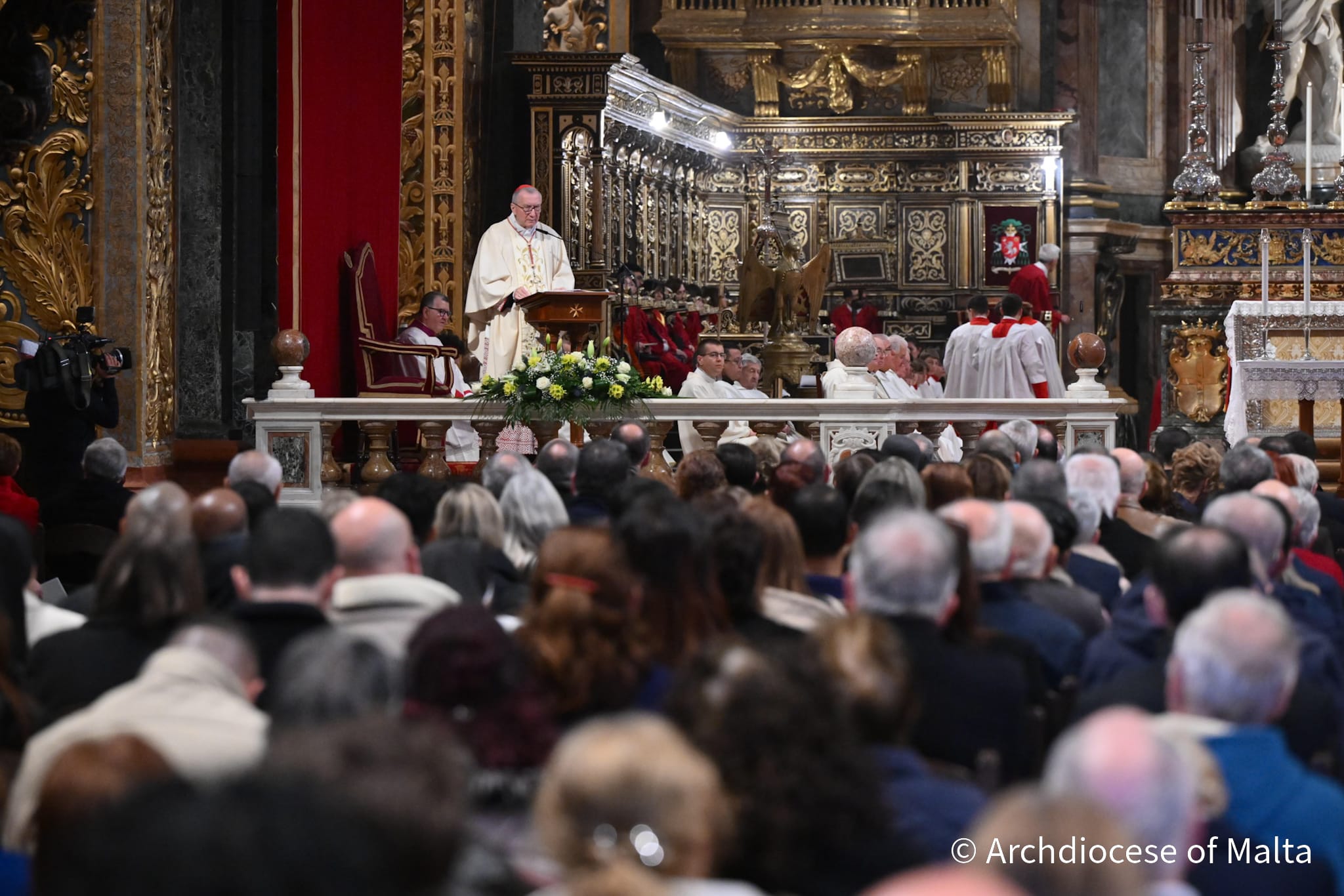





Homily by Cardinal Pietro Parolin
Your Excellencies, brother Bishops,
Honourable Authorities,
Dear Priests and Religious,
My Brothers and Sisters in Christ,
I am grateful to God for the opportunity to celebrate this Holy Mass in this Co-Cathedral of St John, on the 60th anniversary of diplomatic relations between the Republic of Malta and the Holy See. I offer a cordial greeting to all of you here present, also in the name of our Holy Father Pope Leo XIV.
The Word of God proclaimed in this celebration brings us back to one of the most vivid and dramatic pages of the Acts of the Apostles: the shipwreck of St Paul on these very shores (cf. Acts 27-28). It is not only a foundational memory for the Church in Malta; it is also a profoundly evangelical narrative about trust, responsibility, and relationship, spoken into a moment of danger and uncertainty.
St Paul is not a free man in this story. He is a prisoner, carried by forces beyond his control, tossed about by the sea, subject to the decisions of others. And yet, in the midst of the storm, he becomes the one who sees clearly, who speaks with authority, and who sustains hope.
At the height of the tempest, when all hope seems lost, St Paul stands before the crew and passengers and says words that still resound today: “Do not be afraid” (cf. Acts 27:22). He does not deny the danger; the ship will be lost. But he proclaims an even deeper truth: that no life will be lost, because God is faithful.

St Paul’s authority here does not come from rank, power, or force. It comes from his relationship with God and from his sense of responsibility towards others. Though a prisoner, he becomes a guide; though vulnerable, he becomes a source of strength.
This is already a first lesson for us today. True authority, whether spiritual, pastoral, or diplomatic, does not arise from control, but from trustworthiness; not from imposing solutions, but from remaining faithful in moments of trial.
When the ship finally breaks apart and those on board reach land, the narrative does not end in survival alone. It flourishes into encounter. St Luke tells us that the inhabitants of the island showed “unusual kindness” to the shipwrecked (cf. Acts 28:2). This detail is essential. The first Christian act on Maltese soil is hospitality. A fire is lit. Strangers are welcomed. Vulnerability is met with care.
From the very beginning, Malta’s Christian story is marked by this capacity to receive the other, to transform danger into encounter and fear into relationship. St Paul arrives as a stranger, yet he leaves as a father in faith.

The Pauline memory that we celebrate today does not stand alone. It is inseparably linked to communion with the See of St Peter. St Paul brings the Gospel through mission, encounter, and witness; St Peter safeguards unity, continuity, and communion. These two dimensions are not opposed. They belong together. The Church is missionary because she is united; she is united so that she may be sent.
The diplomatic relationship between Malta and the Holy See, established 60 years ago, must be understood in this light. It is not merely a juridical arrangement or a political convenience. It is the institutional expression of a communion already lived, a way of ensuring that encounter, dialogue, and cooperation may continue in an ordered and faithful manner.
The sea that carried St Paul to Malta is not unlike the sea of history through which peoples and nations still sail today. Our world knows continual storms: war, displacement, social fragmentation, and fear of the future. In such moments, the temptation is either to abandon responsibility or to seek security through force.
St Paul shows another way. He remains attentive. He listens. He speaks when necessary. Above all, he reminds everyone that their lives matter and that they are in God’s providential hands. As we heard in the first reading from the Book of Wisdom: “it is your providence, O Father, that steers its course, because you have given it a path in the sea, and a safe way through the waves, showing that you can save from every danger, so that even a person who lacks skill may put to sea” (cf. Wisdom 14:3-4).

This is also the vocation of the Church in the international community. The Holy See does not claim to calm every storm. But it seeks, humbly and persistently, to keep alive the conviction that no one should be lost, that peace is possible, and that dialogue is never in vain.
The establishment of diplomatic relations between Malta and the Holy See 60 years ago did not mark the beginning of a relationship, but the institutional development of a much older, bi-millennial bond. It gave stable form to a dialogue already shaped by history, faith, and shared responsibility.
The Holy See does not claim to calm every storm. But it seeks, humbly and persistently, to keep alive the conviction that no one should be lost, that peace is possible, and that dialogue is never in vain.
Over these decades, this relationship has grown through patience rather than haste, through listening rather than confrontation, through mutual respect rather than confusion of roles. It has shown that Church and State, when each respects the other’s autonomy, can cooperate fruitfully for the common good. Such cooperation is not automatic. It requires humility, clarity, and perseverance – the very virtues praised in today’s readings.

If we look more closely at these 60 years, we see that the relationship between Malta and the Holy See has been marked not by extraordinary gestures alone, but by constant accompaniment.
The Apostolic Nunciature has never been a distant or merely formal presence, but a listening and attentive one – closely attuned to the life of the local Church and deeply respectful of the institutions of the State. At significant moments of social transformation and political maturation, from Independence to European integration, this presence has helped to sustain channels of dialogue, to avert misunderstanding, and to foster solutions rooted in reason, mutual respect, and goodwill.
The agreements concluded over time – concerning education, marriage, ecclesiastical property, and formation – are not merely legal instruments. They are signs of trust patiently built, expressions of a shared desire to serve society without confusion of responsibilities. They reflect a distinctly Maltese way of living Church – State relations: neither confrontational nor clerical, but dialogical and realistic.
This journey has also been enriched by personal encounters. The visits of the Successors of St Peter to Malta have been moments of grace, in which the institutional dimension of relations has been illuminated by great affection, prayer, and shared faith. Once again, Malta welcomed the Successors of St Peter as it had welcomed St Paul – not with fear, but with great enthusiasm and generosity.
At the same time, Malta has not remained inward-looking. Many sons and daughters of these islands have served the Holy See and the universal Church far beyond these shores, carrying with them a sensitivity shaped by hospitality and resilience. In this way, the relationship has never been one-sided; it has been reciprocal, living, and dynamic.
Seen in this broader perspective, our diplomatic relationship is revealed for what it truly is meant to be: not an end in itself, but a means of communion, enabling the Church to fulfil her mission and the State to serve its people for their greatest good.

This passage from the Acts of the Apostles concludes with a simple but powerful statement: “And so it happened that all were brought safely to land” (cf. Acts 27:44). Not the ship, but the people are saved.
This is a profoundly evangelical criterion. Structures change, projects develop, plans may need revision – but persons must never be abandoned. This principle lies at the heart of the Church’s mission and of her diplomatic engagement: the primacy of the human person, created in the image and likeness of God.
Over these 60 years of diplomatic relations, Malta and the Holy See have sought – each in its own fashion – to keep this principle alive: through dialogue, and cooperation.
As we commemorate this anniversary, we are not simply recalling a date. We are reaffirming a vocation. History, as St Pope Paul VI once reminded us, is the place where Christ Himself continues to live, leaving concrete traces and signs of His presence.
The Pauline memory entrusted to Malta is not a relic of the past. It is a responsibility for the present and the future: to remain a place of welcome, a bridge between cultures, a voice for peace rooted in faith.

Brothers and sisters, the shipwreck of St Paul teaches us that God’s purposes are not thwarted by storms. They are often revealed in and through them. When faith remains firm, when hospitality is offered, when responsibility is embraced, the sea does not have the final word. Therefore, let us thank the Lord for his steadfast love, for his wonderful works to humankind. And let us offer thanksgiving sacrifices, and tell of his deeds with songs of joy (cf. Psalm 107:21-22).
As we celebrate this Eucharist, may we entrust once more to the Lord the journey of Malta, the mission of the Church, and the fragile paths of peace in our world. Because our Lord Jesus Christ is the One, who will work with us in proclaiming the good news everywhere, and He will confirm the message by the signs that will accompany it (cf. Mark 16:20).
May we learn from St Paul to trust, from the Maltese people to welcome, and from St Peter to remain united – so that, even amid the storms of our time, all may be brought safely to land. Amen.
✠ Cardinal Pietro Parolin
Secretary of the Vatican State