



Homily of His Holiness Pope Leo XIV
Your Eminences and Your Excellencies,
Dear priests, men, women religious,
Your Majesties,
Dear brothers and sisters,
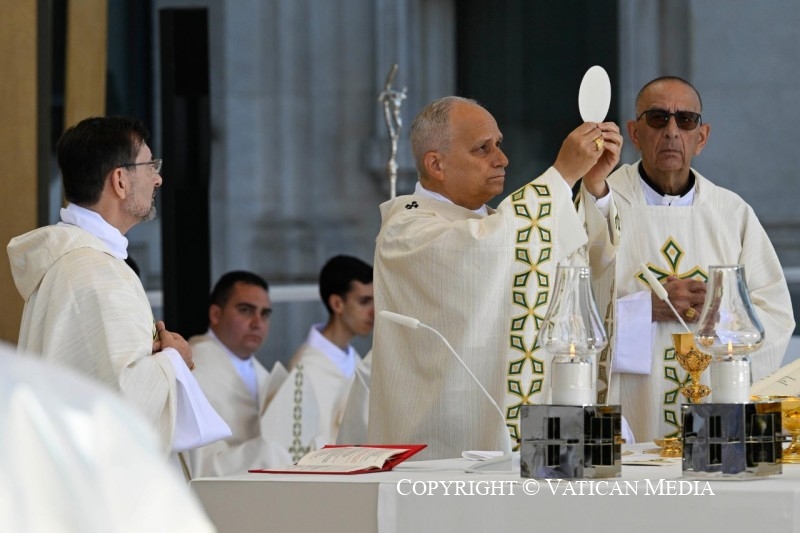
As I begin my visit to Spain, it is with a heart filled with joy that I preside over this celebration on the Solemnity of Corpus Christi.
We are gathered around the Eucharist, the gift of Christ’s living presence among us. He who wished to offer us his life so that we might enter into communion with the Father and become his children, is here as the living Bread come down from heaven, to nourish us with the very life of God, with a love stronger than death.
This awareness of the Lord’s presence in the Eucharistic Bread is deeply rooted in the faith and the history of your people. Here in Madrid, as in many other parts of Spain, Corpus Christi is more than just another celebration on the liturgical calendar. It is a way of returning to the heart of the faith to renew our love and fidelity to God. The solemn processions held on this day have for centuries shaped the piety, art, music, architecture and life of the Spanish people. Even today, they still express and manifest the spiritual sentiments of this country through the beauty and elegance of the floral carpets, the altars erected in the streets, the carefully crafted monstrances and stands, the hymns and the liturgical vestments. This is not an exhibition, a remnant of folklore or a simple display of beauty. It is a profession of faith in the presence of the risen Lord, who is alive and continues to walk among us, who becomes bread to satiate our hunger for life, and visits the recesses of our hearts and history, even those shrouded in darkness.

Just as Christ gives himself as food in the Eucharistic celebration, the procession shows that he is not confined to the church, but comes out to meet us. Jesus travels the streets, crosses the squares and visits our neighborhoods, dwelling in the settings of our daily lives. He is a God who is close to us, who walks with his people, the Lord of history. He is comfort to the weak, light for families, hope for the sick and peace for those who suffer. The Christ who processes through the streets in the monstrance is the same one who identifies with the poor, the downtrodden, those who are alone and forsaken. It is no coincidence that the Church here in Spain has long combined the Solemnity of Corpus Christi with the Day for Charity.
It is not merely a matter of bringing out the monstrance, but of allowing ourselves to be brought out of our selfishness and indifference, of a comfortable, private faith, so as to respond to his invitation to conversion, to change our perspective, and to welcome his presence which transforms us and makes us builders of a new world.
For this reason, the historical memory of the Corpus Christi processions is not confined to wistful nostalgia. Instead, it stands as an invitation in the present moment, in our daily lives, in our relationships, in society, and in the building of the future. It is in this context that we must understand the invitation to “remember” that we heard in the first reading: “Remember the long way that the Lord your God has led you these forty years in the wilderness” (Deut 8:3); remember how he fed you with manna when you were hungry. We must “remember” precisely so as not to forget who the Lord is, so as not to fall into the temptation of trusting in other idols and feeding on bread that does not satisfy.

Herein lies the task of Spain today and in the future: to ensure that the religiosity which has shaped and defined this country for centuries is not a museum of the past to be visited, but a school of faith from which to draw even today: A school that teaches us to kneel before God and before our neighbor, because no one can kneel before the Lord and despise their brother; A school that teaches us of the gratitude of love that becomes a gift, so that it may flow among us and break the chains of all selfishness; A school from which we learn that God is a real presence and that we too are called to be present in the realities and challenges of society, not shying away, but personally committing ourselves to the building of the common good.
Brothers and sisters, I wish to recall Saint Manuel González, the bishop of the abandoned tabernacle. His life reminds us that the Eucharist should be honored not only during great celebrations or on special occasions, but also through the silent fidelity of those who accompany the Lord with a humble and quiet friendship that is nourished day by day. I would also like to bring to mind the poetic verses of Saint John of the Cross: “For I know well the spring that flows and runs, although it is night” (Song of the Soul that Rejoices in Knowing God through Faith). While imprisoned in harsh conditions in the convent prison of Toledo, precisely around the time of Corpus Christi in 1578, he recognized the hidden presence of the Lord in the darkness of his cell, a presence from which emanates a light that never fades and flows a life that never diminishes. The Eucharistic Jesus is “that eternal spring that is hidden” — a spring that flows and quenches thirst, yet without blinding, without imposing itself through outward power, without presenting itself in a spectacular way (cf. ibid.).
Let us return to him with sincere love. Let us open ourselves to the encounter with him, let us allow him to quench the thirst of our hearts, so that we may then go forth into the paths of life and history, bringing to the people this stream of fresh water, a stream of love, peace, justice and joy. Let us drink anew from this Eucharistic spring, which does not enclose us in private devotion, but sends us out to refresh our brothers and sisters, our families, the poor, the suffering, and those who have lost hope. Eucharistic grace transforms us and makes us protagonists of the transformation of history, a sign of hope for those we meet.

May the Lord Jesus, present in the Eucharist, transform you into bread that is broken, given, and offered, so that a life of fullness may spring forth for you, for your families, and for your country.
Source: vatican.va