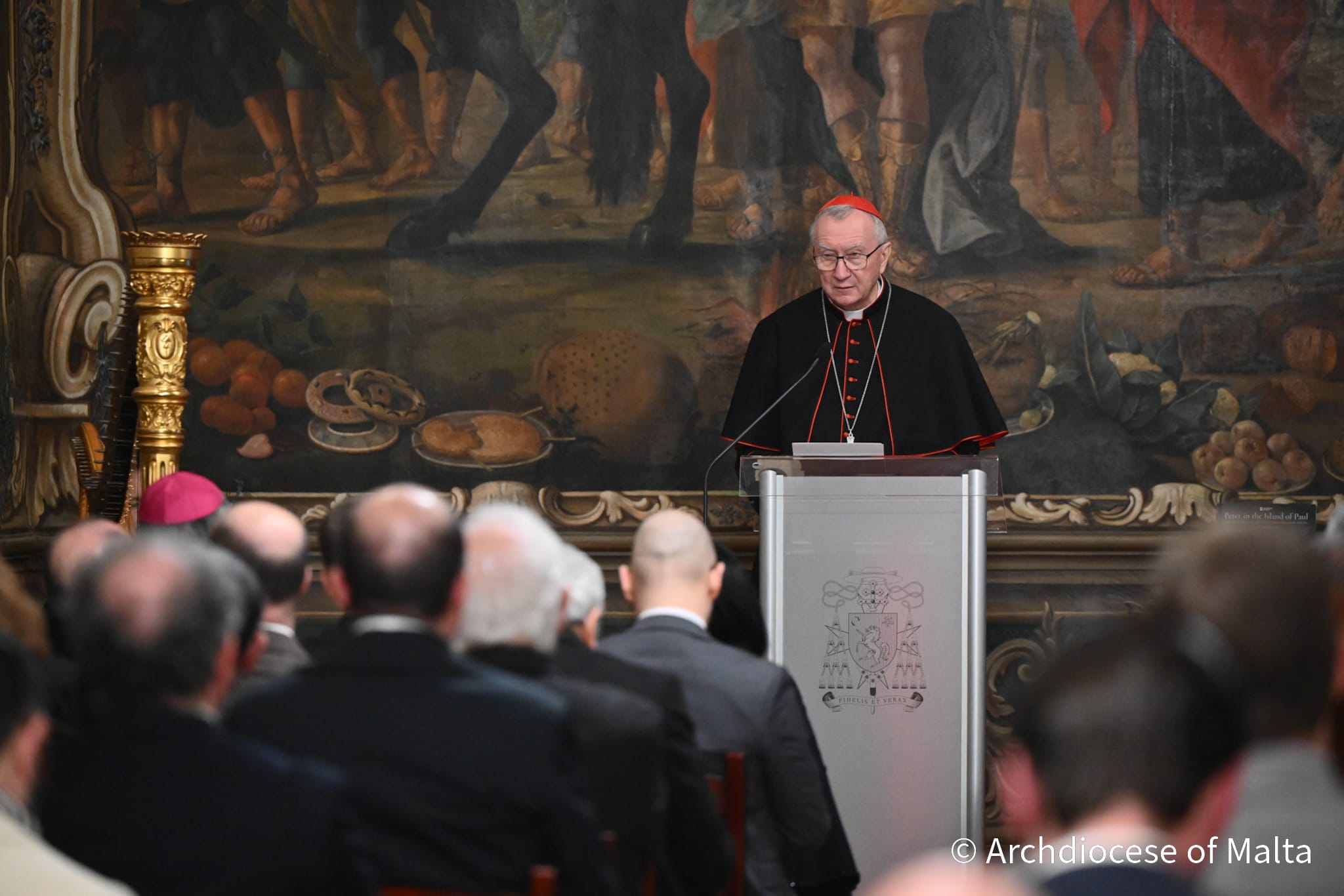





Address by Cardinal Pietro Parolin
Your Excellency, Madam President of the Republic,
Honourable Deputy Prime Minister and Minister for Foreign Affairs and Tourism,
Distinguished Authorities and Members of the Diplomatic Corps,
Your Excellencies, brother Bishops,
Reverend Priests, Religious Brothers and Sisters,
Ladies and Gentlemen,
I am grateful for the opportunity to be with you on this significant occasion, which marks sixty years of diplomatic relations between the Republic of Malta and the Holy See, and which is enriched today by the presentation of two commemorative volumes dedicated to this shared journey.
Anniversaries of this kind are not merely moments of remembrance. They invite us to reflect more deeply on the meaning of relationships – between peoples and institutions, between history and responsibility, and, in the case of the Holy See, between the pastoral mission of the Church and its engagement with the international community.

In his first addresses to the Diplomatic Corps and to Pontifical Representatives, His Holiness Pope Leo XIV has insisted on a fundamental truth: the ministry of Peter is, at its heart, relational. Drawing on the account from the Acts of the Apostles of the healing of the cripple at the Temple, the Pope reminded us that Peter’s first gesture is not one of power, but of encounter – “Look at us” – an invitation to enter into relationship, of recognition, and of hope.
This vision helps us to understand the distinctive nature of pontifical diplomacy. It is not a diplomacy oriented toward advantage or domination, but a diplomacy exercised at the service of communion, attentive to all peoples and cultures, respectful of sovereignty, and animated by the concern for the dignity of every person. Seen in this light, the diplomatic relationship between Malta and the Holy See, formally established on 15 December 1965, appears not as an isolated political act, but as the institutional expression of a much older and deeper bond.
Malta occupies a unique place in the Christian tradition. The account of St Paul’s shipwreck, preserved in the Acts of the Apostles, has shaped the island’s self-understanding for nearly two millennia. The “Apostle to the Gentiles” arrives as a stranger, vulnerable and dependent, and is received with what Scripture calls “unusual kindness”. From this encounter emerges a narrative of hospitality, healing, and faith.

Yet Malta’s Christian identity has not been shaped solely by St Paul. From the earliest centuries, it has also been sustained by communion with the See of St Peter – a communion expressed through Rome’s pastoral oversight, juridical care, and a steady concern for the unity of faith and discipline.
The volume presented today, Peter in the Island of Paul, captures this double trajectory with clarity and depth. It shows how Malta’s history has been forged at the intersection of Pauline openness and Petrine solicitude: mission and governance, hospitality and unity, local identity and universal communion. In doing so, it offers not only a historical reconstruction but also a lens through which to interpret the present.
Cooperation between Church and State, when grounded in mutual respect and clarity of competence, serves the common good rather than undermining it.
The establishment of diplomatic relations in 1965 came at a decisive moment. Malta had recently attained independence, and the Holy See, in the wake of the Second Vatican Council, was rearticulating its understanding of the Church’s presence in the modern world.
Under St Pope Paul VI, the Holy See affirmed that diplomatic representation was not an accessory to the papal ministry, but a concrete expression of what he called the sollicitudo omnium Ecclesiarum (Motu Proprio, 24 June 1969) – the Pope’s paternal responsibility for all the Churches. The Apostolic Nuncio, in this vision, is both a diplomatic representative and a pastoral bridge: accredited to the State, yet also a sign of communion with the local Church.

In Malta, this vision has found a particularly coherent application. Over the past six decades, relations between the Holy See and the Maltese State have developed into a stable and mature concordatarian framework, respectful of democratic institutions while safeguarding the Church’s freedom to fulfil its mission.
The bilateral agreements concluded in areas such as education, marriage, ecclesiastical property, and theological formation testify to a shared conviction: that cooperation between Church and State, when grounded in mutual respect and clarity of competence, serves the common good rather than undermining it.
Malta’s experience also illustrates a broader truth of international life. Size does not determine significance. Though geographically small, Malta has consistently demonstrated an outward-looking vocation – shaped by its history as a crossroads of the Mediterranean, by its experience of resilience, and by its enduring commitment to hospitality. This Archipelago has a particular vocation to play in the service of peace, placed as it is at the very heart of what the Romans of old called the “Mare Nostrum”, acting as a bridge between this Sea’s northern and southern spheres.
This vocation resonates deeply with the diplomatic ethos of the Holy See. In a world marked by fragmentation, conflict, and mistrust, both Malta and the Holy See have learned – each in its own way – that peace is built patiently through dialogue, listening, and fidelity to fundamental values. The Maltese word sliem (peace) expresses more than the absence of conflict; it conveys harmony, reconciliation, and goodwill. It is a word that could well serve as a guiding principle for international relations today.
Commemorative volumes such as the one we present this evening perform an essential service. They preserve memory – not as nostalgia or self-reference, but as a resource for discernment, enabling the present to be read in the light of a lived and meaningful past. By retracing the paths through which relationships were patiently built, at times tested, and ultimately renewed, they help us to approach contemporary challenges with greater wisdom and interior freedom. To borrow once more the words of St Pope Paul VI: “it is Christ who operates in time and it is He Himself who writes its history, so that our pieces of paper are echoes and vestiges of this passage of the Lord Jesus in the world” (Address to Ecclesiastical Archivists, September 26, 1963). Works such as this commemorative volume, therefore, reflect the life of the Church as it unfolds in history, in constant dialogue with the contemporary world, and in fidelity to its mission in every season.

The presence of the Holy See in Malta, through the Apostolic Nunciature, remains a sign of continuity in this rapidly changing world. It reminds us that diplomacy, when inspired by a genuine concern for persons and peoples, can remain humane, ethical, and hopeful.
The Maltese word sliem (peace) expresses more than the absence of conflict; it conveys harmony, reconciliation, and goodwill. It is a word that could well serve as a guiding principle for international relations today.
At the same time, this anniversary invites us to reflect with an eye to the future. The relationship between Malta and the Holy See is not a closed chapter. It continues to unfold amid new questions, which include migration, social cohesion, care for creation, technological change, and the safeguarding of peace in a fragile international order.
Allow me, then, to conclude with a simple but profound image. When St Paul arrived in Malta, shipwrecked and vulnerable, he was received with kindness. When Peter’s successors have come to Malta – through visits, through representatives, through gestures of trust – they too have been welcomed with faith and affection.

May this enduring encounter between Peter and Paul on Maltese soil continue to inspire relations marked by truth and charity, by respect and cooperation, and by a shared commitment to the dignity of the human person. As we give thanks for sixty years of diplomatic relations, may we also renew our resolve to build bridges – patiently and humbly – in the service of peace.
Thank you for your kind attention.
✠ Cardinal Pietro Parolin
Secretary of the Vatican State